


The Canadian seal hunt is highly controversial. Should it be banned? Here’s what we think
By Jody McCutcheon
*Six kinds of seals inhabit the waters off Canada’s Atlantic coast: harp, hooded, grey, ringed, bearded and harbour. Harp seals account for the vast majority of those hunted, so for the purposes of this article, all references to seals shall imply harp seals.
Whomever you talk to, the Canadian seal hunt is a sensitive subject. As far back as 1978, French explorer and conservationist Jacques Cousteau noted the major stakeholders were acting on emotion rather than logic. Today, little has changed. Sealers hunt not for money, but out of tradition, the thrill of the hunt, or ‘conservation’.
On the other side, protesters and animal lovers vehemently denounce the seemingly brutal killing of cute little seal pups. And while animal welfare agencies worldwide encourage bans on Canadian seafood in response to the Canadian seal hunt, the Canadian government continues to heavily subsidise an industry for which international demand is at an all-time low.
The debate focuses on issues of cruelty, conservation and economics. Should the Canadian seal hunt and its ugly “killing floes”come to an end? We’d say yes. And the reasons may not be what you’d expect.
Image below: A mother seal mourns her bludgeoned baby. Picture by the humane society international

A Question of Cruelty
Seals used to be killed for their skin, fat and meat. Adult seal penis bones were also in high demand on the Asian aphrodisiac market. Warm and waterproof, seal pelts made for excellent cold-weather clothing. Seal fat was used as cooking oil, fuel, soap, and lubricants. Seal meat is rich in protein, iron, calcium, magnesium and Vitamins A and B12.
For all these reasons, subsistence hunters, such as the Canadian Inuit, used virtually every part of the seal, plus they hunted mainly adult seals. But today, subsistence hunting accounts for only about three percent of the annual Canadian seal hunt. And frankly, even for native peoples, there are now better, less cruel means of gaining all the products seals used to provide for them.
The other ninety-seven percent of hunted seals is from the so-called ‘commercial hunt’, which targets baby seals (between the ages of two weeks and three months, when pelts fetch the best prices). These hunters take only the pelt, leaving the rest of the corpse to rot. In other words, the hunt is only to serve the fur industry.
A Humane Society report suggests that over 98% of seals killed are younger than three months old. That’s an awful lot of seal pup carcasses rotting on blood-soaked ice floes. To an outsider looking in, the Canadian seal hunt looks gruesome and wasteful.
Baby seals are killed with firearms from long range and hakapiks from short-range. The hakapik is a long-handled hammer with a blunt side for killing and a claw side for dragging. Canada’s MMR require the skull be crushed immediately to minimize suffering. Hakapiks are more reliable than firearms, as long-range rifle shots often only wound the seal, which might then fall off the ice floe and drown, as pups often cannot swim.
Species Hypocrisy?
Anti-sealing activists have used the hakapik to symbolise the inhumane nature of seal-killing. The result is that the Premiers of Newfoundland and Nunavut moved to ban the tool in 2008. In fact, hakapiks are not only more reliable killing instruments than firearms. When properly used, they’re more efficient (i.e., humane) than guns. The American Humane Society even spoke out against the proposed ban, arguing that without the use of hakapiks, seal suffering would increase.
Jacques Cousteau, back in 1978, compared the slaughter of seals with the slaughter of pigs, suggesting pig-killing is equally as vicious, yet is condoned by the consuming public nonetheless. And the truth is – he has a point. If you’re going to protest the killing of animals, you should protest the slaughter of food animals, too. After all, there are literally billions of them killed each year, and in far more brutal conditions. These domestic, sentient animals are usually subjected to extreme stress and misery all their lives, and end their lives witnessing their fellow species being slaughtered, as they wait their turn in a queue.
And the worst part? No matter what animal is being slaughtered, humane killing isn’t always possible, for a variety of reasons. With respect to seals, for example, a 2012 veterinary report suggests that inherent variables in seal-hunting environments, such as high winds, ocean swells, low temperatures and visibility, melting ice floes and the speed at which the killing occurs, prevent consistent application of MMR-sanctioned killing methods.
Another study depicted hunters skinning live seals in up to three of every eight cases. In fact, there’s no denying that seal hunting often descends into brutal cruelty, and some hunters enjoy it. Unfortunately, monitoring the hunt can be difficult, as Department of Fisheries and Oceans (DFO) authorities must police a vast area. The Canadian seal hunt mainly occurs in the Gulf of St. Lawrence and off the Newfoundland-Labrador coast, in an area called The Front, every March and April.
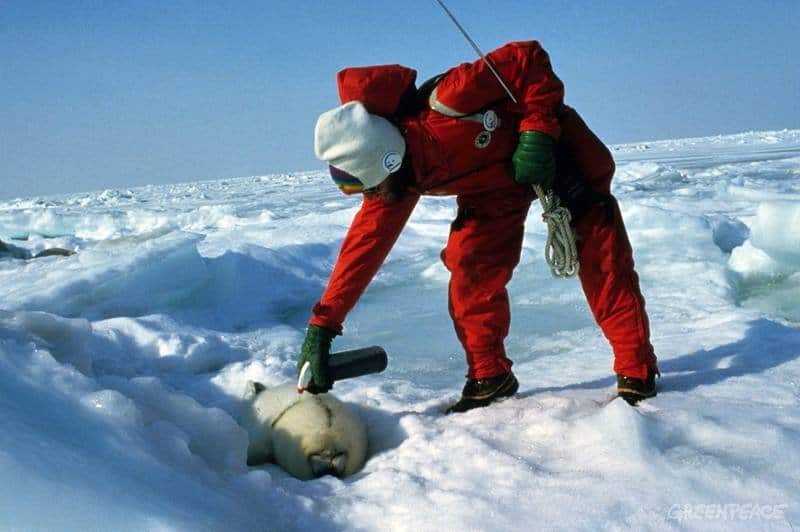
A Question of Conservation?
Then there is the issue of conservation with regards to the Canadian seal hunt. In order to avoid over hunting, the DFO instituted the concept of Total Allowable Catch (TAC) in 1971. Since 2000, the Canadian seal hunt has averaged about 320,000 animals per year. Between 1971 and 2013, sealers harvested an average of about sixty-five percent of the yearly TAC.
According to a 2011 DFO report, the seal population has increased fourfold in that time, to about eight million seals. In the last five years, with worldwide demand for seal products plummeting, the harvest has been about nineteen percent of the TAC. Seals are not an endangered species. And given their rising numbers, we need to consider the relationship between seals and fish.
A seal will eat at least a tonne of fish every year. So, without regular culling of the seal population, Canada’s fish populations may be vulnerable to significant decreases. In fact, the European Union still somewhat hypocritically practices seal culling to protect its own fish stocks, despite having banned seal products from European markets.

Dollars or Sense?
While you’d think the Canadian seal hunt takes place mainly for monetary reasons, the truth is, there’s less and less demand for seal-based products.
Perhaps for that reason, the Newfoundland-Labrador government subsidised the sealing industry to the tune of $3.6 million in 2013. And now the province and the Feds have teamed up on a $500,000 marketing campaign to promote seal meat domestically and abroad, even though there’s no traditional market for seal meat outside Newfoundland-Labrador and Asia.
Yet at least twenty-three countries have banned the import of seal products, including major markets Russian, Taiwan, Mexico, the EU and US. Canada appealed to the World Trade Organization for exemption status, but the WTO recently upheld the ban.
In the face of collapsing international demand, what point is there in adding new regulations and subsidising sealers to hunt unwanted seals? These measures seem like desperate attempts to keep a dying industry on life support.
Look at it this way: the 2004 seal harvest was worth CAD$16.5 million, not even three percent of Newfoundland-Labrador’s $600 million fishing industry. That’s without accounting for subsidies. More recently, the 2011 seal hunt was worth just over CAD$1 million. On average, commercial fishermen-cum-sealers earn less than 5% of their annual income through the seal hunt. From a pure number-crunching perspective, the seal hunt makes little in terms of dollars and sense.
A Plea For Logic
So, should the Canadian seal hunt be banned? That’s a hard YES. Not because the seals are killed inhumanely, or because it’s cruel, or due to conservation issues, or because sealers will lose their economic lifeblood. No, the Canadian seal hunt should simply be nixed because there is no reason for it.
Why are innocent animals being bludgeoned to death when international demand for seal products is all but dead.? There’s no commercial market. People are as appalled by the killing of these animals as they would be by the mass slaughter of kittens.
Those who argue that the seals need culling to save fish stocks forget that it’s we humans who have depleted them, not seals.
The reality is – we humans need to stop messing with this planet and the animals we share it with. Period.
Do you believe the Canadian seal hunt should be stopped? Sign this petition!
Sources used for this article:
https://www.ifaw.org/eu/press-releases/2021-canada-commercial-seal-hunt-begins
https://www.humanesociety.org/resources/about-canadian-seal-hunt
https://www.harpseals.org/about_the_hunt/quota_tac.php
Images: Main: Pixabay 3&4: Greenpeace 5: Wikicommons

- Meet Ethical Fashion Designer Kelli Donovan - July 26, 2025
- 7 Of The Best Clean At Sephora Makeup Brands - July 13, 2025
- Eluxe Horoscopes For July 2025 - June 30, 2025