

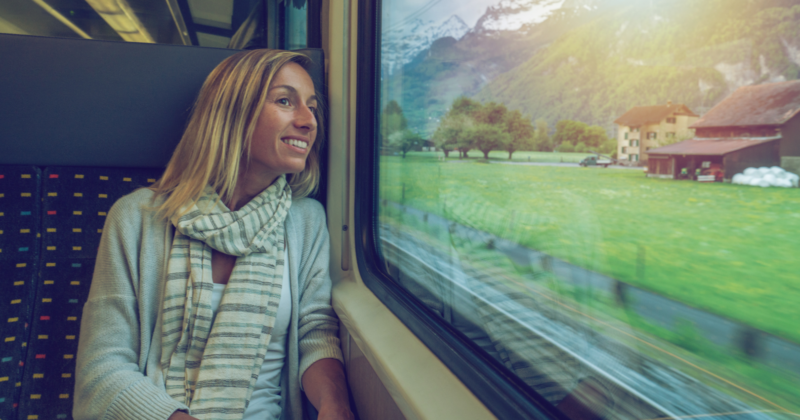
You know that moment when you step off a Swiss alpine train and the silence hits you? Not just quiet, but that particular mountain silence where you can actually hear snow settling on pine branches and your own heartbeat slowing down to match the rhythm of the place. That’s when I realized Switzerland had quietly revolutionized sustainable travel while the rest of us were still arguing about carbon offsets.
After spending years helping people untangle their complicated lives, I’ve noticed something fascinating: the solutions that actually stick are rarely the dramatic ones. They’re the gentle shifts that feel so natural you wonder why you ever did things differently. Switzerland’s approach to sustainable travel works exactly this way. It doesn’t ask you to sacrifice comfort or convenience. Instead, it offers something better than what you thought you wanted.
Why trains became the heart of Swiss travel
The Swiss didn’t just build a railway system; they created a moving meditation practice that happens to take you places. When I took the Glacier Express from Zurich to Zermatt last spring, eight hours passed like a dream sequence. No checking emails at red lights, no GPS recalculations, no searching for parking. Just panoramic windows framing scenes that shift from emerald valleys to snow-draped peaks while you sip wine from the Valais region.
Everett Potter, a travel writer, captures the magic perfectly: “The highest point on the journey is 7,391 feet above sea level at Ospizio Bernina, the highest crossing of any train in the Alps without a tunnel.”
Think about that for a second. You’re gliding through the roof of Europe powered by hydroelectric energy from the very mountains you’re crossing. The trains run on renewable energy, arrive within seconds of their scheduled time, and connect to buses that reach villages so remote you’d swear they were invented for fairy tales.
What really got me was watching a grandmother with her groceries, a group of teenagers with snowboards, and international executives with briefcases all sharing the same train car. Public transport here isn’t a last resort; it’s the obvious choice. The Swiss Travel System operates like clockwork because, well, Swiss clockwork is redundant at this point, isn’t it?
Car-free villages that make you question urban planning everywhere
Remember when you were a kid and could play in the street without your parents hovering? That’s everyday life in places like Zermatt, Wengen, and Mürren. These villages banned cars decades ago, and walking through them feels like stepping into an alternate timeline where urban planners actually listened to residents.
In Wengen, I watched children sledding down the main street while their parents chatted over glühwein at outdoor cafes. No honking, no exhaust fumes, no constant vigilance for traffic. Electric taxis quietly ferry luggage to hotels, and everything else moves at human speed. The absence of engines creates space for other sounds: conversations in multiple languages, church bells marking time, the crunch of boots on fresh snow.
Mike MacEacheran describes it beautifully: “Zermatt is a destination where winter sports are always worth the effort and the atmosphere is that of a collective lottery win.”
That collective lottery win feeling? It comes from everyone agreeing to the same simple rule: no cars. The result transforms these villages into living rooms where the mountains provide the walls and the streets become shared spaces for actual living, not just transit.
How cable cars and mountain railways redefined accessibility
Here’s something that might surprise you: making remote peaks accessible by cable car actually protects them better than keeping them off-limits. When a gondola powered by mountain streams can whisk you to a glacier in twelve minutes, nobody needs to build roads. When cogwheel trains climb through three climate zones in two hours, helicopter tours lose their appeal.
The infrastructure itself becomes part of the experience. Taking the train to Jungfraujoch isn’t just transportation; it’s a gradual acclimatization to altitude, a lesson in geology visible through the windows, and a shared adventure with strangers who become temporary friends over hot chocolate at the summit station.
I met a couple from Japan who’d been planning this trip for three years. They told me they chose Switzerland specifically because they could reach every destination on their list without renting a car. The woman pulled out a notebook where she’d mapped their entire journey using trains, boats, and cable cars. It looked like abstract art, all these colorful lines connecting dots across the country.
The unexpected pleasure of slow travel rhythms
You know how in relationships, the best conversations happen during long drives when you’re both looking ahead instead of at each other? Swiss train travel creates that same dynamic with the landscape. You’re moving through it together, at a pace that allows for actual observation rather than just glimpses.
I started noticing things I’d miss from a car: how Swiss farmers stack their wood in patterns that could be gallery installations, how each valley has its own architectural dialect, how the light changes personality as you climb from lake level to glacier. This isn’t slow travel as a trendy concept; it’s travel at the speed of comprehension.
Hotels here understand this rhythm too. They participate in sustainability programs that track everything from water usage to food miles, but they present it as hospitality rather than homework. Your room key doubles as a free transport pass. Breakfast features cheese from the dairy you passed on yesterday’s hike. The hot water for your bath comes from geothermal springs. None of this feels preachy or sacrificial. It just feels thoughtful.
What sustainable infrastructure actually looks like
The Swiss approach reminds me of something I tell clients about building healthy habits: the best systems are invisible until you need them. Every Swiss town, no matter how small, connects to the public transport network. Tourist cards include free bus and train travel, gently nudging visitors away from rental cars. Restaurants accessible only by hiking trail or gondola thrive because getting there becomes part of the experience.
Even the signage reflects this integration. Yellow signs mark hiking trails with precise walking times. Digital boards at bus stops show real-time arrivals. Train platforms indicate exactly where each car will stop. It’s infrastructure designed to eliminate anxiety, not create it.
Final thoughts
Switzerland taught me that sustainable travel isn’t about giving things up. It’s about discovering that what you thought you needed (a rental car, constant connectivity, the illusion of speed) was actually getting in the way of what you really wanted: genuine connection with a place and its rhythms.
When I work with clients struggling to make changes in their lives, I often think about those Swiss mountain trains. They don’t fight the landscape; they follow its contours. They don’t rush; they maintain a steady pace that gets everyone where they need to go. They create space for the journey to be as meaningful as the destination.
Maybe that’s the real lesson here. Sustainability works when it offers something better than what it replaces. In Switzerland, trading your car keys for a train pass doesn’t feel like a compromise. It feels like finally understanding what luxury actually means: time to notice, space to breathe, and the confidence that comes from knowing you’re traveling in harmony with the place you’ve come to see.

- The most sustainable ways to travel through Switzerland: from alpine trains to car-free villages that make slow travel feel like the only sensible choice - April 27, 2026
- 9 grocery shopping habits of people who eat consciously without making it a full-time job - April 27, 2026
- 9 vegan baby food recipes that make plant-based weaning feel achievable rather than overwhelming - April 26, 2026