

Last week, I watched a friend frantically rearrange her living room for the third time in a month.
She’d bought another throw pillow set, a new side table, and some trendy wall art she’d seen on social media.
Yet somehow, the room felt less inviting than before.
The problem wasn’t what she was adding.
The problem was that she kept adding without ever subtracting.
Most people believe that transforming a living room requires constant additions: new furniture, fresh decor, the latest design trends.
But after shifting to minimalism in my early thirties and watching my own space transform, I’ve learned something different.
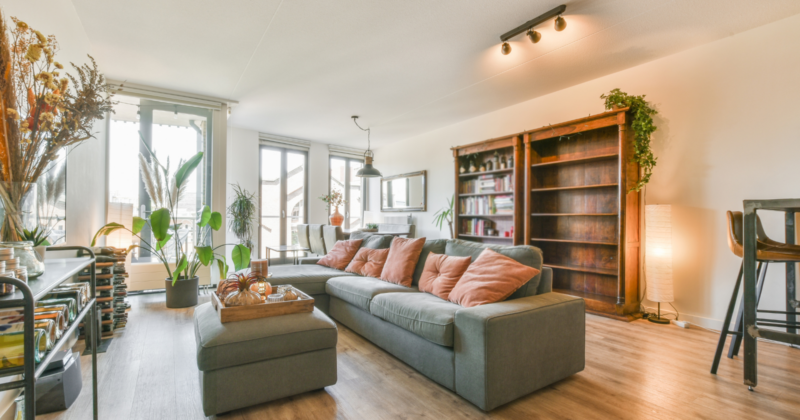
The most beautiful living rooms breathe.
They have space for light to move through them.
They invite you to sit down without navigating an obstacle course of ottomans and accent tables.
Today I’ll share the seven conscious purchases that actually transform a space, based on years of curating my own minimalist apartment and helping others find clarity in their homes.
1) One quality sofa that fits your actual life
Your sofa sets the entire tone of your living room.
Not just visually, but functionally.
I spent years with a massive sectional that dominated my space because I thought bigger meant better.
Every gathering felt cramped despite having “more seating.”
The walkways were narrow.
The room felt heavy.
When I finally invested in a well-made, appropriately sized sofa that actually fit my lifestyle and space, everything shifted.
The room opened up.
Movement became fluid.
Conversations felt more intimate rather than spread across a vast expanse of cushions.
Consider how you actually use your living room.
Do you host large gatherings weekly, or is it mostly you and your partner?
Do you need a sofa that doubles as a guest bed, or would a sleek two-seater serve you better?
Research shows that spatial layout and furniture significantly impact our physical and mental health, particularly as we age.
The right sofa isn’t just about aesthetics.
Choose based on your real patterns, not imagined scenarios.
2) Lighting that creates atmosphere, not just brightness
Most living rooms suffer from one overhead light that casts harsh shadows and kills any sense of warmth.
Or worse, they’re lit entirely by the blue glow of screens.
Strategic lighting transforms a space more dramatically than almost any other single change.
I learned this the hard way after years of wondering why my living room never felt quite right despite having beautiful furniture.
The solution came through layering: one floor lamp with warm bulbs for reading, a table lamp for ambient evening light, and simple dimmers on overhead fixtures.
The same room now shifts from bright and energizing during morning yoga to soft and calming for evening meditation.
Quality doesn’t mean expensive here.
A simple dimmer switch costs less than most decorative items but creates infinitely more impact.
3) One piece of art that speaks to you
Empty walls can feel cold, but walls covered in random prints feel chaotic.
The sweet spot lies in selecting one or two pieces that genuinely resonate with you.
Not what’s trending.
Not what matches your throw pillows.
Something that makes you pause when you look at it.
In my apartment, I have one large photograph from a trip to Lisbon that reminds me to slow down every time I see it.
That single piece does more for the room than a gallery wall of impulse buys ever could.
Art should tell your story, not fill space.
When you choose pieces that matter to you, guests feel it too.
The room becomes personal without being cluttered.
4) Storage that disappears
Here’s what nobody talks about: the most transformative purchase for any living room is often hidden storage.
Beautiful spaces stay beautiful because they have somewhere for life’s necessities to go.
• A coffee table with hidden compartments for remotes and chargers
• A sleek console that holds board games and extra throws
• Built-in shelving that displays a few treasured items while hiding the rest
Before I understood this principle, I constantly battled visible clutter.
Now, everything has a home that doesn’t announce itself.
The room stays serene even when life gets messy.
5) Natural elements that bring life
Plants do something no manufactured object can achieve.
They add life, literally.
But here’s where people go wrong: buying dozens of small plants that require different care routines and create visual noise.
Instead, choose one or two larger plants that thrive in your specific light conditions.
A single fiddle leaf fig or a well-placed snake plant adds more presence than a windowsill crammed with succulents.
If plants feel like too much commitment, a beautiful wooden bowl or a piece of natural stone can provide that organic element without the maintenance.
The goal is to bring nature inside, not recreate a greenhouse.
6) Textiles that invite touch
The difference between a room you look at and a room you live in often comes down to texture.
A quality throw blanket in natural fibers.
Cushions that actually support you rather than just matching a color scheme.
A rug that defines the space without overwhelming it.
I learned this from studying Scandinavian design principles, where texture takes precedence over pattern.
My living room has exactly three textiles: a wool throw, two linen cushions, and a jute rug.
Each one invites you to touch it.
Each one serves a purpose beyond decoration.
When you limit quantity but maximize quality, every piece works harder.
7) Negative space as a conscious choice
This might be the hardest “purchase” of all: the decision to buy nothing.
To leave corners empty.
To resist filling every surface.
Empty space isn’t wasted space.
In Japanese aesthetics, this concept is called “ma” – the pause between notes that makes the music.
When I first embraced minimalism, leaving space felt uncomfortable.
Now I understand that space is what makes everything else visible.
The beautiful sofa stands out because there isn’t a side table crammed next to it.
The art commands attention because the walls around it breathe.
Final thoughts
The most beautiful living rooms tell a clear story about the people who live in them.
Not through accumulation, but through careful curation.
Each item earns its place.
Each purchase solves a real problem or brings genuine joy.
Your living room doesn’t need more stuff.
What would happen if you removed three items from your living room today instead of adding one?
Sometimes the most powerful transformation comes not from what we bring in, but from what we’re brave enough to let go.

- Why the most beautiful living rooms are never the most cluttered ones: the 7 conscious purchases that genuinely transform a space - April 29, 2026
- People who grocery shop consciously almost always do these 7 things differently (and most of them have nothing to do with buying organic) - April 28, 2026
- Everything conscious parents need to know about raising a vegan baby: the recipes, the nutrition basics, and the questions worth asking your paediatrician - April 27, 2026