

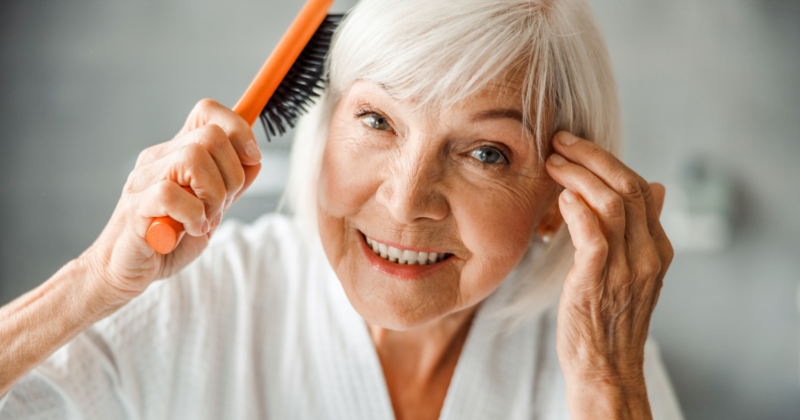
Last month I stood in the shampoo aisle for twenty minutes, completely overwhelmed. The bottles promised volume, shine, repair, miracles. I picked up a purple one claiming to banish yellow tones, then put it back. At 63, my hair had become this strange territory I no longer recognized. Thin where it used to be thick. Wiry where it used to be smooth. And somehow both dry and greasy at the same time.
I’d been following the same routine since my thirties. Wash every other day, condition the ends, blow dry on medium heat. But somewhere around 58, that stopped working. By 60, I was buying every product marketed to “mature” hair, spending ridiculous amounts on serums and treatments that left my hair looking worse than before.
The breaking point came when my seven-year-old grandson touched my hair and said it felt “crunchy.” Kids don’t lie. That afternoon, I stripped everything back and started over.
The hormone shift nobody warns you about
Here’s what I wish someone had told me: menopause doesn’t just end. The hormonal changes keep evolving through your sixties. Your scalp produces less oil, but not uniformly. Some areas stay oily while others turn into the Sahara. The texture changes aren’t just about thinning. Individual strands actually change shape, which is why your old styling tricks stop working.
I learned this from a dermatologist I met through work. She was doing home visits for one of my patients, and we got talking. She said most women treat their hair problems when they should be treating their scalp. The skin up there ages just like the skin on your face, but we ignore it completely.
That conversation changed everything. I stopped thinking about my hair as this separate thing that needed fixing and started thinking about my whole head as an ecosystem that needed care.
Why less really is more after 60
I cut my routine down to three products. That’s it. A gentle cleanser, a leave-in treatment, and a light oil for the ends. No more weekly masks that weighed everything down. No more volumizing mousse that made my hair crispy. No more heat protectant spray that seemed to attract every particle of dust in a five-meter radius.
The cleanser isn’t even shampoo anymore. It’s a cleansing conditioner, sometimes called co-wash. Sounds fancy but it’s not. It’s just a creamy formula that cleans without stripping. I massage it into my scalp for a full minute, which feels strange at first when you’re used to quick lathering. But that massage is doing more work than any product could.
The leave-in treatment is the lightest one I could find. Most are too heavy for hair that’s already struggling. I apply it to damp hair, just a tiny amount, working from the middle to the ends. Never the roots. That took some relearning because I’d been told for years to condition from root to tip.
The oil is argan, but honestly, any light oil works. Three drops maximum, warmed between my palms, then pressed into the very ends. That’s all.
The washing schedule that changed the game
I wash my hair once a week now. Sometimes I stretch it to ten days. The first month was rough. My scalp rebelled, producing oil like it was making up for lost time. But I stuck with it, using dry shampoo sparingly on day four or five if needed.
By month two, my scalp had adjusted. The oil production normalized. My hair actually looked better on day three than day one. It had body without being greasy, and the texture had softened.
The key was the water temperature. Hot water was making everything worse. Now I wash with lukewarm water and do a final rinse with cold. Not ice cold, just cool enough to make me catch my breath. It’s become part of my routine, like my ocean swims. That little shock that tells your body to wake up and adapt.
Air drying isn’t just for the young
I stopped blow drying completely. This was the hardest change because I’d been taught that professional women don’t show up with wet hair. But blow drying was making my hair frizzier and more brittle with every passing year.
Now I wash my hair in the evening, let it air dry while I’m reading or watching something, and sleep with it in a loose braid. In the morning, I undo the braid and have these soft waves that actually suit my face better than the blown-out style I’d been forcing for decades.
On mornings when I swim, I wet my hair with fresh water before getting in the ocean. This stops the salt water from penetrating as deeply. After, I rinse with the beach shower and let it dry naturally on the walk home. The salt actually gives it texture that expensive sea salt sprays try to replicate.
The unexpected mental shift
Simplifying my hair routine did something I didn’t expect. It freed up mental space I didn’t know I was using. All those products, all that time spent trying to make my hair look like it did at 40, all that money on solutions that didn’t work. It was exhausting in a way I only recognized once I stopped.
My hair isn’t perfect now. It’s thinner than I’d like. The color is this interesting mix of silver, white, and my original brown that can look amazing or terrible depending on the light. But it’s healthy. It’s soft. It moves when I walk.
More importantly, I’m not fighting it anymore. I’m working with what I have instead of against it. At 5:30 in the morning, when I’m getting ready for a shift or heading to the beach, I run my fingers through it, maybe add a tiny bit of oil if it needs it, and I’m done. Two minutes maximum.
This isn’t about giving up or not caring about appearance. It’s about recognizing that the rules change, and that’s okay. The products that worked at 40 won’t work at 60. The styling that suited you then might not suit you now. Your hair is telling you what it needs if you stop drowning out the message with seventeen different products.
Start simple. Strip everything back. Pay attention to your scalp, not just your hair. Give any new routine at least six weeks before you judge it. And remember that “mature hair care” is mostly marketing. What you need is gentle, consistent care that works with your hair’s new reality, not against it.
Your seven-year-old grandson probably won’t comment on the texture anymore. Mine doesn’t. Now he just says grandma’s hair smells nice, which is the coconut scent from the argan oil. That’s a review I’ll take.

- What nobody tells you about caring for your hair in your 60s: the clean, simple routine that finally worked for me - April 21, 2026
- I’ve lived in Sydney for decades and these are the 8 outdoor adventures I still come back to, none of them cost a thing - April 21, 2026
- 7 Australian animals on the brink of extinction — and what living alongside native wildlife for decades taught me about why it matters - April 20, 2026