

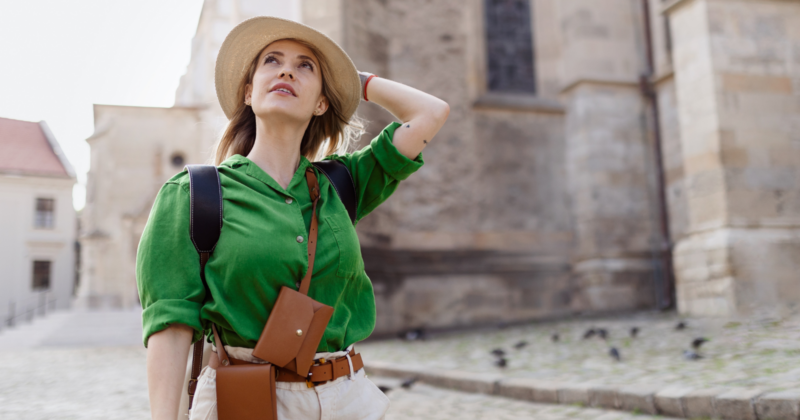
The rental car counter at Athens airport had seventeen different insurance options. I stood there at midnight, jet-lagged after twenty-four hours of flying, trying to remember which Greek islands I’d planned to hit in my ten days. Santorini, Mykonos, Crete, maybe squeeze in Rhodes. The woman behind the counter kept asking questions about collision damage waivers while I calculated ferry schedules in my head.
That was 2018. My first proper overseas trip after the divorce, and I was determined to see everything.
Last year, I went back to Greece. Stayed three weeks on one island. Naxos. Learned the baker’s name, found the beach where the locals swim, discovered that the best tomatoes come from the stall run by the woman with the blue headscarf who sets up on Thursdays. And here’s the thing: I created less than half the carbon footprint of that first frantic trip.
The checklist mentality costs more than money
Most of us approach travel like we’re collecting stamps. Three days in Paris, two in Rome, quick stop in Florence. We burn through fuel jumping between destinations, generate mountains of single-use plastics from constant transit meals, support the worst kind of mass tourism infrastructure. All to say we’ve been there.
I used to do the same thing with domestic trips. Drive six hours to the Blue Mountains for a weekend, race through three different walks, drive home exhausted. The car alone would chew through a tank and a half of petrol. These days, I take the train up, stay a full week in one spot, walk the same trails at different times of day. The mountains actually reveal themselves when you stop rushing past them.
The environmental math is straightforward. Every flight, every car rental, every hotel change multiplies your impact. But staying put for two weeks instead of city-hopping for one? Your per-day footprint drops dramatically. You’re not constantly in transit. You’re not eating airport food wrapped in plastic. You’re not supporting the infrastructure built for tourists who’ll never return.
What happens when you stay still
When you slow down, something shifts. You stop needing the tourist restaurants. After four days on Naxos, I was buying vegetables from the market and cooking in my apartment. By week two, I knew which cafe used local honey, which taverna caught their own fish. The owner of the bakery started setting aside the bread I liked.
This isn’t just romantic nonsense about authentic travel. When you stay longer, you naturally start living more like locals do. You walk to the market instead of grabbing packaged food. You figure out the bus system instead of taking taxis. You eat what’s in season because that’s what the local places serve.
During my bushwalking years, I’ve watched the same thing happen on trails. The people rushing to complete the whole track in record time miss everything. They’re so focused on the destination they don’t notice the bower bird’s nest, the way the light changes through the tree ferns, the swimming hole that’s not on any map. They also tend to leave more rubbish, cause more erosion, disturb more wildlife.
The resistance to slowing down
I know what you’re thinking because I thought it too. But I only get two weeks of leave. But I might never come back. But there’s so much to see.
That scarcity mindset drives the worst kind of tourism. We treat places like items on a grocery list, rushing through because we might not get another chance. But here’s what I learned after decades of putting everyone else first: when you try to have everything, you usually end up with nothing worth keeping.
The afternoon I spent swimming with an elderly Greek woman who taught me to float on my back without fear? That’s worth more than photos from six different islands. She showed up at the same cove every day at 3 PM. I’d never have met her if I’d been racing to catch a ferry.
How local becomes sustainable
When you stay longer, you start to see how places actually work. On Naxos, I learned the water comes from a single desalination plant. Once I knew that, my showers got shorter. I noticed how the locals never buy bottled water, they fill containers from the springs. I started doing the same.
You begin to understand what damages a place and what sustains it. The quad bikes tearing up the walking paths. The cruise ships dumping thousands of people for three hours. The hotels built on turtle nesting beaches. When you’re rushing through, you don’t see these connections. You’re part of the machine without realizing it.
Staying put also means you can choose better accommodation. Instead of whatever’s available for one night, you can find the family-run place that employs locals, sources food from nearby farms, uses solar hot water. These places often cost less for weekly stays anyway.
The unexpected gift of boredom
By day ten on Naxos, I’d run out of sights to see. No more temples to photograph, no more museums to tick off. So I sat at the harbor and watched the fishing boats come in. Helped an old man untangle his nets because I had nowhere else to be. Walked the same coastal path three times and noticed different wildflowers each time.
This is when travel becomes something else. Not consumption but presence. Not taking but participating. The environmental benefit is real, less transport, less consumption, less pressure on tourist infrastructure, but there’s something else too. You start to feel like you belong somewhere, even temporarily.
Making the change
You don’t need to quit your job and become a nomad. Start with your next trip. Instead of four cities in two weeks, try two. Instead of a weekend race through the wineries, stay put in one town and actually taste the place.
Book accommodation with kitchens so you can shop at markets. Look for direct flights rather than connections. Take trains where possible. Pack lighter so you’re not lugging excess weight that burns more fuel. Stay somewhere walkable. These aren’t sacrifices. They’re choices that usually make trips better anyway.
What we’re actually looking for
After all these years in nursing, watching people at their most vulnerable, I’ve learned something about what we’re actually seeking when we travel. It’s not the photos or the passport stamps. It’s the feeling of being fully alive, fully present, fully ourselves in a new place.
You can’t get that in three days. You can’t get it racing between monuments. You get it by staying long enough to have a routine, to be recognized, to understand how a place breathes.
The most sustainable thing you can do as a traveler isn’t buying carbon offsets or packing a reusable straw. It’s slowing down enough to realize that the point was never to see everything. It was to see something, really see it, and let it change you a little.
That’s what happened on Naxos. Not because it was special, but because I stayed long enough to let it be ordinary. And in that ordinary rhythm, shopping at the market, swimming at the same beach, walking the same hills, I found what I’d been racing around looking for all along.
- What the Great Ocean Walk taught me about the difference between visiting nature and actually being in it - April 13, 2026
- Why the most environmentally responsible thing I ever did as a traveller was slow down, stay longer, and stop treating destinations like a checklist - April 13, 2026
- After 40 years of nursing I noticed the same pattern in almost every woman who came in for something serious — she had been quietly ignoring it for months because everyone else’s needs felt more urgent than her own - April 13, 2026