

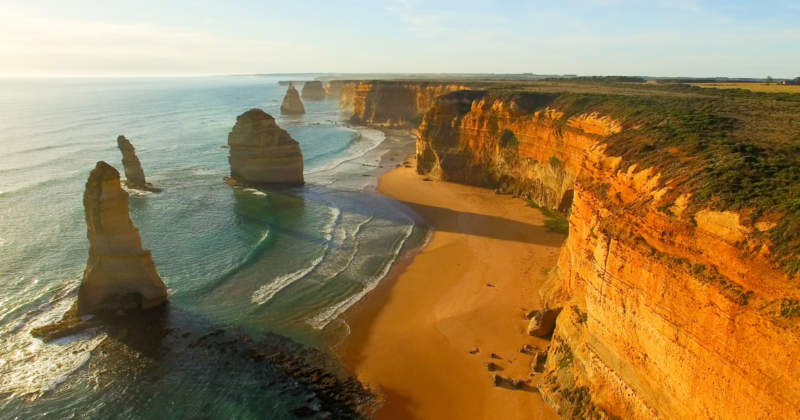
Seven days walking the Great Ocean Walk, and somewhere around day three, knee-deep in mud after scrambling down a cliff face to avoid high tide, I finally understood something. There’s a world of difference between looking at the ocean from a viewing platform and having sand in places you didn’t know sand could reach.
The moment everything shifted
Most people drive the Great Ocean Road. They stop at the Twelve Apostles, take their photos, maybe grab a coffee at Apollo Bay. I used to be one of them. Quick stops, nice views, back in the car. Tick the box, move on.
But walking those 100 kilometres from Apollo Bay to the Twelve Apostles? That’s when nature stops being scenery and starts being something you’re actually part of. You don’t just see the weather change. You feel it coming in your bones, watch the birds go quiet, taste the salt shift in the air.
Kate Hennessy captured it perfectly: “Perhaps it’s the moody weather but the beaches on the Great Ocean Walk have a kind of exhilarating end-of-the-world bleakness.” That bleakness isn’t depressing. It’s electric. Standing on those beaches with nothing between you and Antarctica makes you feel properly alive in a way that no lookout ever could.
Your body becomes the compass
When you’re actually in nature for days, not hours, your body starts to sync with everything around you. I’d wake up just before dawn without an alarm. My stomach would growl right as I reached the spots where I’d planned to eat lunch. By day four, I could predict rain about two hours out, just from how the air felt on my skin.
This doesn’t happen when you’re visiting. When you drive to a waterfall, snap some photos, and drive home, you stay in your regular rhythm. Your body never gets the chance to recalibrate. You remain a tourist in your own experience.
Walking the coast every afternoon with my old dog has taught me this same lesson on a smaller scale. After months of the same track, I know which rocks get slippery first when rain’s coming. I know where the bower birds are building. I notice when the banksia starts flowering three days earlier than last year. You can’t download this kind of knowing. You have to earn it with time and presence.
The difference between consuming and connecting
Here’s what nobody tells you about those famous coastal views: they look completely different at 3pm than they do at sunrise. Different again in fog. Different when you’re exhausted. Different when you’ve just seen a whale breach. Different when your feet are screaming and you still have three hours to walk.
When you visit nature, you consume it. Nice view, great photo, what’s next? When you’re actually in it, nature consumes you right back. It gets under your skin, literally. Salt crystals form on your eyebrows. Your hair becomes a nest of tangles that no amount of conditioner will fix. You start smelling like the earth you’ve been walking on.
Visiting is about control. You choose when to arrive, when to leave, what to see. Being in nature means surrendering that control. The tide dictates when you can pass certain beaches. The weather decides if you’ll eat lunch huddled under a tree or sprawled on warm sand. A wombat might reorganise your entire afternoon just by deciding to graze exactly where you planned to camp.
Getting comfortable with discomfort
Day five of the walk, everything hurt. My right knee was having opinions about every downhill step. Blisters had formed in spots I didn’t know could blister. The romantic idea of wilderness walking had well and truly worn off.
But something interesting happens when you can’t just get in your car and leave. You adapt. You learn to walk differently to protect the blisters. You find a rhythm that works with your cranky knee, not against it. You stop fighting the discomfort and start working with it.
This never happens on day trips. The moment something gets uncomfortable, we leave. Too hot? Head home. Bit of rain? Back to the car. We never stay long enough to move through the discomfort and find what’s on the other side of it.
Ocean swimming taught me this years ago. The water’s cold every single morning. But if you only ever stand at the edge, testing it with your toes, you’ll never know how good it feels once your body adjusts. You have to commit, get in, stay in. Same with walking. Same with any real encounter with the natural world.
Why the difference matters
After decades of putting everyone else first, these long walks have become my way of putting myself back together. Not the quick beach visits between shifts or the hurried dog walks before cooking dinner. The real ones. The ones where I’m out long enough that my phone battery dies and I stop caring.
There’s something about being properly in nature that strips away all the roles we play. Out there, I’m not a nurse, not someone’s mother, not anyone’s anything. I’m just another animal moving through the landscape, trying to find water, shelter, the next safe spot to rest.
When you visit nature, you bring all your usual mental chatter with you. The to-do lists, the worries, the replaying of conversations. But when you’re in it long enough, that noise eventually stops. Has to. Your brain needs all its bandwidth just to navigate what’s right in front of you.
The path forward
Not everyone can take a week off to walk 100 kilometres of coastline. I get that. But the principle works at any scale. Instead of driving to five different lookouts in a day, pick one trail and walk it properly. Instead of photographing the sunrise and heading home, stay for the morning. Watch how the light changes. Notice which birds appear when.
My coastal walks with the dog started as ten-minute obligations. Now they’re two-hour adventures where we know every tree, every tide pool, every spot where the whales come close to shore in winter. The difference isn’t the place. It’s the practice of returning, staying, paying attention.
Nature isn’t a destination to visit. It’s a relationship to develop. And like any relationship, it only deepens when you show up consistently, stay present even when it’s uncomfortable, and stop trying to control the experience.
The Great Ocean Walk taught me that the magic isn’t in the viewing platforms or the famous rocks. It’s in the moments between: the unplanned detour when high tide blocks your path, the weird bird call you can’t identify, the blister that forces you to slow down and actually see where you are.
That’s when you stop being a visitor and start being part of the landscape. That’s when nature stops being out there and starts being right here, in your bones, under your skin, changing you from the inside out.
- What the Great Ocean Walk taught me about the difference between visiting nature and actually being in it - April 13, 2026
- Why the most environmentally responsible thing I ever did as a traveller was slow down, stay longer, and stop treating destinations like a checklist - April 13, 2026
- After 40 years of nursing I noticed the same pattern in almost every woman who came in for something serious — she had been quietly ignoring it for months because everyone else’s needs felt more urgent than her own - April 13, 2026