

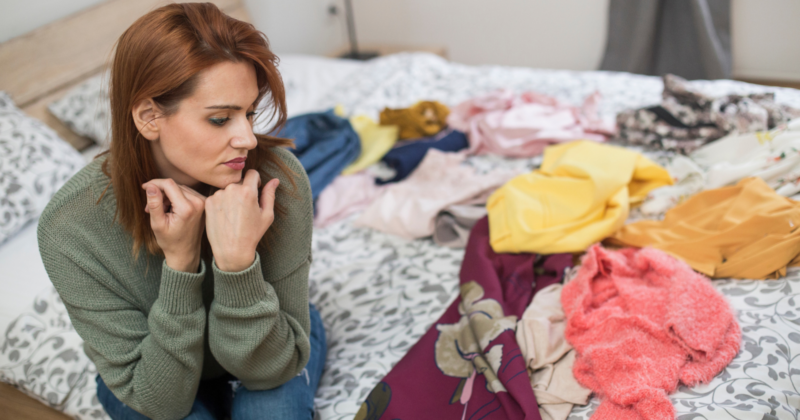
You know that moment when you’re standing in front of your closet, already late, grabbing the same worn hoodie for the fourth day straight? That was me last month, except I wasn’t just late. I was empty.
I’d been counseling couples through their toughest moments for over a decade, but somehow missed the warning signs in my own reflection. The baggy sweaters, the same pair of leggings on repeat, the way I’d stopped wearing anything that required an iron.
My wardrobe had become a confession I wasn’t ready to hear.
Your closet knows before you do
Here’s what I’ve learned after years of watching clients walk through my office door: the clothes we reach for when we’re depleted aren’t random choices. They’re messages from the part of us that’s too exhausted to use words.
I had a client once, a marketing director who managed multi-million dollar campaigns. For three months, she showed up to our sessions in perfectly pressed blazers. Then one day, she arrived in her college rowing team sweatshirt. “I don’t know why I wore this,” she said, almost apologetically.
But her body knew. That sweatshirt was from a time when she was part of something bigger, when effort had immediate results, when she could physically feel her own strength. She was trying to return to a version of herself that felt powerful in a different way.
Ankita Guchait, MBPsS, a mental health practitioner, puts it perfectly: “Clothing influences mood, confidence, behaviour, and even how safe or exposed we feel in the world.”
Think about that. Safe or exposed. Your morning clothing choice isn’t just about fashion or comfort. It’s about how protected you need to feel that day.
The three uniforms of exhaustion
After years of observation, both in my practice and my own life, I’ve noticed three distinct patterns that emerge when we’re running on emotional fumes.
First, there’s what I call the “fortress dresser.” This person suddenly starts overdressing for everything. Need milk from the corner store? Full face of makeup. Video call with no camera required? Statement earrings anyway. They’re building armor out of accessories, hoping that looking pulled together will somehow pull them together.
Then there’s the “ghost dresser.” Everything becomes about blending in, disappearing. Beige, gray, black. Oversized everything. Nothing that might invite conversation or attention. I lived in this space for six months after my father passed. Every morning, I’d choose clothes that whispered rather than spoke.
The third pattern is the “time traveler.” Old concert tees resurface. The dress from your honeymoon makes regular appearances. You find yourself wearing things from specific periods of your life, usually happier or simpler ones. Your body is literally trying to wear its way back to a different emotional state.
What happened when I finally listened
Last winter, I noticed I’d been wearing my husband’s old flannel shirt to bed every night for two weeks. Not occasionally. Every. Single. Night.
At first, I told myself it was just comfortable. But if I’m honest, and this is what I tell my clients all the time, comfort is rarely just about fabric.
That flannel was from our first apartment, when we’d stay up until 3 AM talking about everything and nothing. When Sunday mornings meant nowhere to be. When we were too broke to eat out but rich in ways we’d forgotten to count.
I was wearing it because somewhere deep down, I was grieving the simplicity we’d traded for success. My body was telling me what my busy mind couldn’t compute: I missed us. Not the current us, drowning in schedules and responsibilities, but the earlier us who had time to really see each other.
The morning check-in that changes everything
Now I practice something I call the “honest inventory.” Before I get dressed, I stand in front of my closet and ask myself one question: What does my body need to feel today?
Not what does my calendar need me to look like. Not what would make the right impression. What does my actual body, my nervous system, my emotional self need to feel?
Sometimes the answer is structure. A blazer that holds me together when I feel like I’m falling apart. Sometimes it’s softness. The cashmere sweater that feels like a hug I’m not getting anywhere else. Sometimes it’s brightness, a splash of red when my internal world has gone gray.
The key is to listen without judgment. If you need to wear your partner’s hoodie to feel connected, wear it. If you need your power suit to remember your strength, put it on. If you need pajama pants under your dress because that’s the only way you can face the day, that’s information worth noting, not a failure worth hiding.
Why this matters more than you think
A few months ago, a client showed up wearing what she called her “depression uniform.” Black leggings, oversized gray sweater, no jewelry, hair in the same messy bun for probably the third day.
“I look pathetic,” she said.
“You look honest,” I replied.
We spent that session not talking about her marriage or her work stress, but about what her body was trying to tell her through those clothes. The leggings? She needed flexibility, permission to move or not move.
The oversized sweater? She was trying to create a boundary between herself and the world. The absence of jewelry? She was too tired to carry anything extra, even earrings.
By naming what her clothes were saying, she could finally name what she was feeling. Depleted. Overwhelmed. Desperate for someone to notice she was drowning without her having to say it out loud.
The path back to yourself
Recovery doesn’t mean forcing yourself into pencil skirts when your soul needs sweatpants. It means listening to what your clothing choices are telling you and responding with compassion instead of criticism.
Start small. Pick one item in your closet that makes you feel genuinely good. Not impressive, not appropriate, but good. Wear it tomorrow. Notice how it feels. Notice what changes.
Then pay attention to patterns. Are you reaching for the same things repeatedly? Are you avoiding certain pieces? What were you feeling the last time you wore that dress you keep pushing aside?
Your wardrobe is having a conversation with you. The question is: are you listening?
Final thoughts
That morning last month, standing in my closet in my worn hoodie, I finally heard what my body had been trying to tell me. I wasn’t just tired. I was empty in a way that no amount of coffee or positive self-talk could fix.
So I did something radical. I honored it. I wore the hoodie. I canceled my non-essential meetings. I told my husband I needed help. I admitted to myself that being strong all the time was making me weak.
Your clothes aren’t lying to you. They’re reflecting a truth your mind might not be ready to acknowledge. That ratty t-shirt you can’t stop wearing? The formal clothes gathering dust? The yoga pants that have never seen a yoga class? They’re all data points in the story of where you really are versus where you’re pretending to be.
The outfit you put on when you’re running on empty isn’t a fashion failure. It’s your body’s wisdom made visible. And maybe, just maybe, it’s exactly what you need to wear until you’re ready to fill back up again.
Because sometimes the bravest thing you can do is admit that today, the soft pants win. And that’s perfectly okay.

- The outfit you put on when you’re running on empty is telling you something your mind hasn’t admitted yet — and it’s worth paying attention to - April 12, 2026
- Women who protect even one hour a day purely for themselves aren’t being selfish — they’re usually the most emotionally available people in the room and here’s why that’s not a coincidence - April 12, 2026
- 7 ways to eat consciously while travelling without being the person at the table making everyone uncomfortable - April 12, 2026