

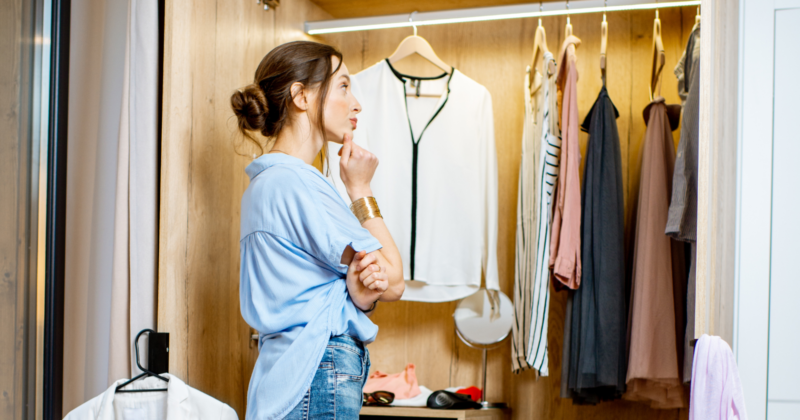
I used to stand in my closet every morning, surrounded by clothes I’d bought to project an image that wasn’t even mine.
The silk blouses that screamed “professional.”
The designer jeans that whispered “effortlessly cool.”
The statement jewelry that announced “creative and interesting.”
None of it felt like me.
I’d spent seven years in marketing communications for wellness brands in NYC, and somewhere along the way, I’d turned myself into a brand too.
Every purchase was calculated.
Every outfit was strategic.
I was dressing for phantom judges who existed only in my head.
The turning point came when I realized I was spending hundreds of dollars each month on clothes to impress people whose opinions I didn’t actually value.
People I wouldn’t even choose to have coffee with.
That revelation hit hard.
The psychology behind dressing for others
Growing up, I developed serious people-pleasing patterns.
My family dynamics taught me that keeping others happy meant staying safe.
That avoiding conflict meant being liked.
These patterns followed me into adulthood and straight into my wardrobe.
As a highly sensitive person, I pick up on every micro-expression, every shift in energy.
I used to think I could control how others perceived me through my clothing choices.
Wear the right outfit, get the right response.
Simple equation, right?
Wrong.
The exhaustion of maintaining multiple versions of myself through clothing was crushing.
Work Isabella wore structured blazers and pointed-toe flats.
Weekend Isabella wore trendy athleisure that cost more than my grocery budget.
Date-night Isabella wore uncomfortable dresses that required special underwear.
None of these versions felt authentic.
I was performing my life rather than living it.
The real cost of a performative wardrobe
Beyond the financial drain, dressing for others created a constant mental load.
Every morning started with anxiety.
What would people think?
Would this outfit make me look successful enough?
Young enough?
Put-together enough?
The questions never stopped.
I’d change outfits three times before leaving the apartment.
I’d buy clothes online late at night, seeking the dopamine hit of finding the “perfect” piece that would finally make me feel adequate.
My closet became a monument to my insecurity.
Here’s what I discovered: when you dress for others, you’re essentially saying your own opinion of yourself matters least.
You’re placing your worth in the hands of people who probably aren’t even paying attention.
Most people are too worried about their own appearance to scrutinize yours.
Starting the shift toward authentic dressing
My journey toward dressing for myself began when I embraced minimalism in my early thirties.
Clutter made my mind noisy, and my overstuffed closet was the loudest room in my apartment.
I started by asking myself hard questions.
Which pieces made me feel genuinely good?
Not confident in a performative way, but comfortable in my own skin?
The answers surprised me.
My favorite items were often the simplest:
• The cotton t-shirt I’d owned for five years
• The jeans that fit perfectly without trying
• The wool sweater David bought me because he thought the color matched my eyes
• The sneakers I could walk miles in without thinking about my feet
These weren’t the pieces that got compliments.
They weren’t trendy or particularly stylish.
But they felt like me.
What my wardrobe looks like now
Today, my Upper West Side apartment closet tells a different story.
Everything in it serves a purpose.
Everything fits.
Everything feels good against my skin.
I own exactly seven pairs of pants.
Three are jeans in slightly different washes.
Two are comfortable work pants in navy and black.
One pair of yoga pants that I actually do yoga in.
One pair of linen pants for summer.
That’s it.
My shirt collection is equally curated.
White cotton tees.
A few striped long-sleeves.
Solid color button-ups in fabrics that don’t require special care.
Two sweaters that layer well.
The color palette is intentionally limited: navy, white, grey, black, with touches of olive and burgundy.
Everything mixes.
Nothing clashes.
Getting dressed takes under two minutes.
I don’t own a single piece of statement jewelry anymore.
Just my wedding ring, a simple watch, and small gold hoops I’ve worn daily for three years.
No more necklaces that tangle.
No more bracelets that clank during yoga.
No more earrings that hurt by noon.
The unexpected benefits of dressing for yourself
Something interesting happened when I stopped dressing for others.
People started complimenting my style more.
Not my clothes, but my style.
The ease.
The confidence.
The consistency.
When you dress authentically, it shows.
Your body language changes.
You stop fidgeting with uncomfortable fabrics.
You stop adjusting ill-fitting pieces.
You move through the world like someone who has nothing to prove.
Because you don’t.
My morning routine transformed completely.
No more decision fatigue.
No more outfit anxiety.
Just reach for what feels right and go.
The mental space this created was profound.
I had more energy for writing.
More presence during meditation.
More patience in my marriage.
Who knew that simplifying my wardrobe could ripple out into every area of my life?
How to start dressing for yourself
Pay attention to what you reach for on your laziest days.
Those pieces you wear when nobody’s watching?
They’re telling you something.
Notice which clothes make you feel physically comfortable.
Sensory comfort matters more than you think.
Scratchy fabrics, tight waistbands, and pinching shoes aren’t just physical irritants.
They’re constant reminders that you’re performing rather than being.
Start small.
You don’t need to overhaul everything at once.
Choose one category to simplify first.
Maybe it’s shoes.
Maybe it’s work clothes.
Find what genuinely works for your body and lifestyle.
Release what doesn’t.
Trust your first instinct when getting dressed.
Before the voice of doubt creeps in, before you start imagining judgments, what does your body want to wear?
Final thoughts
I spent years and thousands of dollars trying to dress my way into other people’s approval.
All it got me was a cluttered closet and a confused sense of self.
Now, my wardrobe is smaller but more “me” than ever.
Each piece earns its place through comfort, functionality, and that ineffable feeling of rightness.
Some mornings I look in the mirror and think I look great.
Other mornings I don’t.
The difference is that now, both experiences are okay.
Because I’m not dressing for the mirror, or for the street, or for the office.
I’m dressing for the person who has to live in these clothes all day.
Me.
What would change if you stopped treating your body like a billboard for other people’s approval?

- I spent years buying clothes to impress people I didn’t even like — here’s what my wardrobe looks like now that I only dress for myself - April 11, 2026
- 7 things that changed when I started investing in ethical fashion instead of fast fashion — and why there’s no going back - April 11, 2026
- The slow travel philosophy that changed how I explore cities: why I now visit one neighbourhood deeply instead of rushing through ten - April 10, 2026