

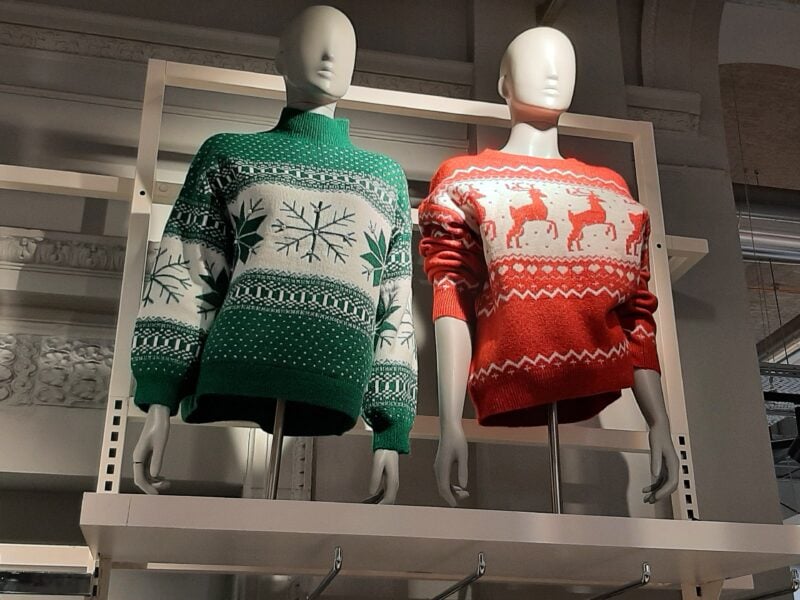
Photo: Hortensja Bukietowa / Wikimedia Commons, CC BY-SA 4.0
An ethical Christmas jumper in 2026 comes down to two routes: one bought new in certified organic cotton, or one somebody else has already worn. Both were live and priced on 16 November, and both will cover an office party, a school concert and Christmas Day lunch.
What follows is one new jumper with its details stated on the brand’s own page, where to find second-hand ones at charity-shop prices without leaving the sofa, and how to keep whichever you choose out of the bin in January.
New and certified: Rapanui’s Cycling Christmas Jumper, £40
Rapanui lists its Cycling Christmas Jumper at £40 on its own site, where the copy calls it “a more sustainable Christmas bike jumper”. A cycling motif rather than a snowflake scene is the reason it can carry on as ordinary winter kit once the decorations are down.
What the product page states:
- Price: £40 on 16 November
- Fabric: “Certified organic cotton sweatshirt, heavyweight 300 gsm” — gsm is grams per square metre, so this is a substantial sweatshirt weight rather than a thin novelty one
- Colours: black, evergreen and navy blue
- Fit: oversized, relaxed
- Care: wash cool, hang dry
- Other wording on the page: “GM-free. Not tested on animals. Does not contain animal-derived products.” The page also describes the jumper as “Made in factories audited for a wide range of social and sustainability criteria.”
Take the animal-derived line as written: it is the brand’s own phrasing, and the page does not use the word vegan. The page gives the fibre as certified organic cotton without a percentage breakdown, so treat that as the limit of what is stated.
If wool matters to you more than a festive print, the companion guide to ethical knitwear for winter 2026 covers British and recycled wool pieces built for the months after December.
One sizing note: an oversized, relaxed cut in 300 gsm cotton is roomy by design, so size down rather than up if you want it close under a coat.
Second-hand from £11.99: Christmas jumpers on Oxfam’s online shop
Oxfam puts donated stock on its online shop, which means a Christmas jumper can be searched by size instead of hunted down on a rail. On 16 November, jumpers graded Used: Very Good were priced from £11.99 to £12.99.
Live examples on the day:
- Fruit of the Loom Texas Christmas Jumper, black, size L — £11.99, Used: Very Good, listed by Oxfam Shop Headingley
- Atmosphere Christmas Jumper, grey, size 16 — £12.99, Used: Very Good, listed by Oxfam Original Liverpool
- H&M Divided Penguin Flip Christmas Jumper, jet black, size S — £12.99, Used: Very Good, listed by Oxfam Original Liverpool
Licensed-character designs were also live at £12.99 and sell out. Each listing is a single donated garment in a single size, so the festive section rotates and the three above may have gone already. Plan around the price band rather than any one item.
Two things to check before filling a basket. Condition is graded on each listing, so read whether a jumper is Used: Very Good or a lower grade, and look at the photographs for bobbling or a stretched neckline. UK standard delivery is listed at £3.95 per order on those pages, so two jumpers in one order work out cheaper per jumper than two separate orders.
For a wider second-hand hunt — the kind that turns up a 1980s hand-knit rather than a recent high-street novelty — the roundup of the best fashion brands to buy vintage is a sensible starting point.
How to make a Christmas jumper last more than one party
The lowest-impact jumper is the one already in the wardrobe. If you are buying, buy for a decade of Decembers rather than one night out.
- Favour one colour and one motif. A plain evergreen or navy ground with a single graphic dates more slowly than an all-over print, and it passes as ordinary knitwear away from the party.
- Skip battery packs and glued-on extras. Light-up wiring, plastic baubles and stick-on tinsel break first, and they are what stops a jumper being easy to pass on or donate.
- Read the care label. Second-hand listings give brand, size and condition; fibre content is easier to judge in the hand, so if a photograph shows the label, zoom in before buying.
- Wash cool and hang dry. That is Rapanui’s instruction for its cotton sweatshirt, and it suits most heavyweight cotton jumpers. Tumble drying is what shrinks and distorts them.
- Mend small holes in January. A darn on a seam buys another year, and bobbling on cotton comes off with a fabric shaver.
- Store it with the decorations. Folded into the box with the lights, it reappears every year instead of being bought twice.
- Pass it on rather than binning it. A wearable jumper belongs in a charity donation bag, not the recycling bin and certainly not general waste. Oxfam’s online stock exists because somebody did exactly that.
For children, second-hand makes the most obvious sense. A jumper worn to two parties before it is outgrown is closer to a loan than a purchase, and it can go back to a charity shop next autumn for the next family.
Every price here was live on 16 November. Second-hand listings rotate, so check the size, the condition grade and the price at the point of buying rather than relying on a saved screenshot.

- Gmail alternatives that run on green energy: Tuta, Posteo and mailbox.org encrypt mail in Germany - November 16, 2026
- A 20p deposit on plastic bottles and cans starts in England, Scotland and Northern Ireland on 1 October 2027 - November 16, 2026
- Silicosis among the workers who cut quartz countertops has California proposing a ban: what to choose instead - November 16, 2026