

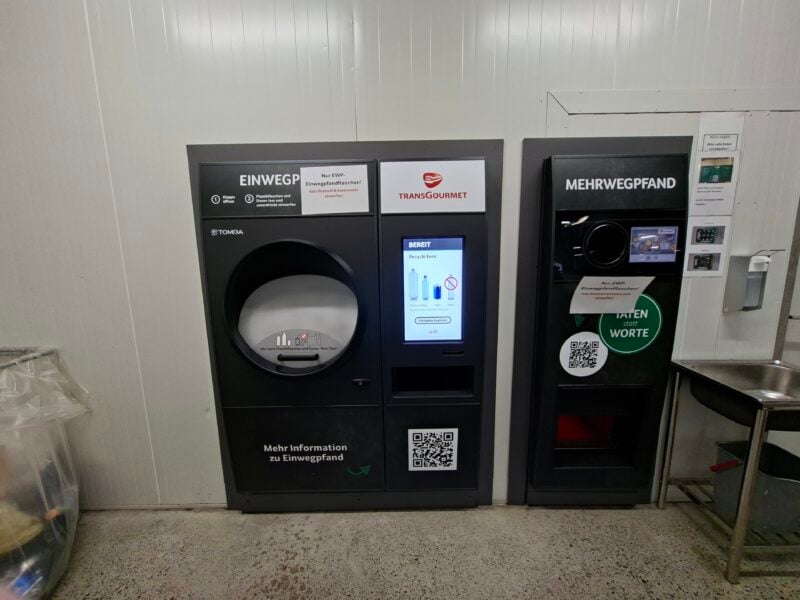
Photo: Bottle and can reverse vending machines in Schwarzach, Vorarlberg, Austria (generic; not a UK scheme machine). Asurnipal / Wikimedia Commons, CC BY-SA 4.0. Share-alike: derivatives must use the same licence.
From 1 October 2027, a refundable 20p deposit will be added at the point of purchase to single-use drinks containers made of PET plastic, steel and aluminium sold in England, Scotland and Northern Ireland, and refunded when the empty container is handed in.
Exchange for Change, the not-for-profit, industry-led organisation delivering the Deposit Return Scheme across the three nations, has confirmed that “a flat 20p deposit will be applied on all in-scope containers when the scheme launches in October 2027”. The deposit applies to containers between 150ml and 3 litres and is fully refundable when they are returned.
It is charged per container, not per pack. The Scottish Environment Protection Agency gives the arithmetic: “for a multipack containing six drinks the deposit would be £1.20”. SEPA describes it as “a refundable 20p charge which is added to scheme articles”. The refund matches the deposit, 20p per container, whatever the drink inside.
What carries a deposit, and what does not
In England, Scotland and Northern Ireland, a container is in scope if it is:
- single-use
- made wholly or mainly of aluminium, steel or PET plastic
- between 150ml and 3 litres in capacity
That covers water bottles, fizzy drinks cans and plastic soft drink bottles. Other everyday containers fall outside it.
Glass is not on the list for those three nations. Neither is HDPE, the material used to make milk bottles, so plastic milk bottles carry no deposit. Containers larger than 3 litres or smaller than 150ml are also outside the scheme.
Scotland’s rules sit in separate legislation. SEPA defines a scheme article as single-use packaging made from PET plastic, steel or aluminium, between 150ml and 3 litres, first made available on or after 1 October 2027 for retail in Scotland.
Cafés, restaurants and pubs are treated differently. Premises selling drinks for immediate consumption can choose not to charge the deposit at the point of sale.
For households buying bottled water by the crate, the deposit changes the sums at the shelf edge, and the containers only hold their value if they come back. Eluxe has compared the options in its look at whether bottled or tap water is the better choice.
Where the empties go back
Shops that sell the drinks will generally have to take the containers back. GOV.UK guidance for England and Northern Ireland sets the obligation out in one line: “Supermarkets, grocery stores, convenience stores and newsagents that sell drinks in the scheme must host a return point for drinks containers, unless they qualify for an exemption.”
The exemption matters. Retailers in urban areas are exempt from hosting a return point if they have a retail space of less than 100 square metres, though they can still apply to be a voluntary return point. Not every shop will take empties back.
Other details to know before launch:
- A return point can be manual or automated using a reverse vending machine.
- Refunds can be given by voucher, card or cash.
- Hospitality venues, gyms, schools and others can apply to host a voluntary return point.
- Online retailers can register as takeback service providers, so containers delivered to the door have a route back.
The Exchange for Change announcement discusses a target of returning 90 per cent of containers within three years, set out there as research context rather than a guaranteed outcome.
A deposit gives an empty container a cash value that is paid back at a return point. Readers weighing where household recycling ends up can read the Eluxe examination of whether recycling is really worth the effort.
Wales is running its own scheme, with glass included
Wales launches on the same date, 1 October 2027, under its own 2026 regulations, and its scope is wider. The Welsh scheme takes in PET plastic bottles, aluminium and steel cans and glass bottles between 150ml and 3 litres from day one. Welsh ministers set out the plans in a written statement published on 12 February 2026.
Glass gets a four-year transition. From 1 October 2027 to 30 September 2031, glass bottles in Wales carry a 0p deposit and no scheme labelling requirement. After that, a monetary deposit and labelling apply to glass.
Plastic and metal are treated differently from the start. The explanatory memorandum to the Welsh regulations says: “All other in-scope drink containers (made from PET plastic, aluminium and steel) will attract a monetary deposit value from day one, in line with the schemes in the other UK nations.”
The Welsh figure is not fixed in the way the 20p is for the other three nations. The memorandum says the deposit management organisation “will set the deposit value, which is modelled at a flat rate of 20p per unit”. A modelled rate is a planning assumption, not a set price.
The practical difference sits with glass. A glass bottle bought in Wales is inside the Welsh scheme at 0p until 30 September 2031, while the same bottle bought in England, Scotland or Northern Ireland is outside the deposit scheme.
Nothing changes at the till before the launch date. From 1 October 2027 the deposit is added at the point of purchase and refunded in full when the container is returned to a return point.

- Gmail alternatives that run on green energy: Tuta, Posteo and mailbox.org encrypt mail in Germany - November 16, 2026
- A 20p deposit on plastic bottles and cans starts in England, Scotland and Northern Ireland on 1 October 2027 - November 16, 2026
- Silicosis among the workers who cut quartz countertops has California proposing a ban: what to choose instead - November 16, 2026