

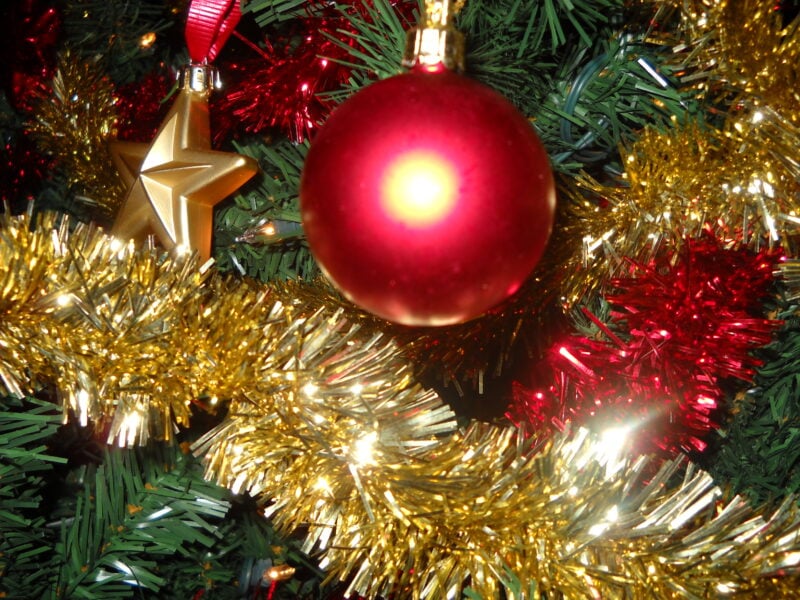
Photo: Jennifer C. / Wikimedia Commons, CC BY 2.0
Broken Christmas lights count as small electricals in the UK, which means they belong at a Recycling Centre, an electrical bring bank or a retailer that accepts old electricals, not in the household recycling bin. Tinsel works the other way round: it cannot be recycled, so the aim is to keep it in use for as many years as possible and treat the bin as the last resort.
The two rules are easy to mix up when the lights and the tinsel come off the tree in the same armful. Sorting them takes minutes. Here is what each one needs.
Christmas lights are small electricals, so recycle them as WEEE
Recycle Now classes Christmas lights and fairy lights as small electrical items that can be recycled at Recycling Centres. The test it gives is simple: “Any items that have a plug, use batteries, need charging or have a picture of a crossed out wheelie bin on, are known as Waste Electrical and Electronic Equipment (WEEE).” A string of fairy lights meets that test whether it runs off the mains, a battery pack or a cable.
Two things follow. Recycle Now says such items should not be sent to landfill. And then the instruction most households get wrong: “Do not put the lights directly into your recycling bin.”
Where a dead set can go instead:
- A Recycling Centre. Zero Waste Scotland gives the same route for Scottish households: “You can recycle your twinkly lights at household waste recycling centres along with electrical items (WEEE).” Look for the WEEE or small electricals container rather than the metals skip.
- An electrical item bring bank. Some local authorities also provide special collection bins at other sites, supermarket car parks among them.
- Via electrical retailers. That is Recycle Now’s wording, and read it literally. Some shops take old electricals back, others do not, and the terms vary, so check with the retailer before making the trip. There is no blanket free take-back at every shop.
- Kerbside, but only if your council says so. Some local authorities accept small electricals such as Christmas tree lights as part of their home recycling scheme, and there may be special instructions, for example placing them in a clear plastic bag tied to the recycling bin. Recycle Now’s advice is to check with the council first.
If you are not sure what is near you, the Recycle Your Electricals postcode locator covers centres, shops, charities and community drop-off points across the UK; as of 16 November its homepage says there are almost 30,000 locations on the locator. The campaign’s line applies to the rest of the house as well as the tree: “Anything with a plug, battery or cable can be reused or recycled.”
Before writing a set off, plug it in and check. A set that still lights is a set you do not have to replace, and recycling is for the ones that have genuinely failed.
Tinsel cannot be recycled, so give it a long life instead
Tinsel is the clearest case in the decorations box. Zero Waste Scotland is direct about the end point: “Tinsel… is not recyclable. If your tinsel has finally lost its sparkle and is no use to family or friends then it needs to be thrown away and will need to go into your non-recycling bin.” Baubles sit in the same bracket, and the advice there is to give away anything you no longer need rather than putting it in the bin.
So the order of operations is reuse, pass on, then bin:
- Store it so it survives. Tinsel tangles and sheds when it is crushed into a sack. Wind each length around a cardboard tube or a strip of stiff card and box it flat.
- Offer it before you replace it. Family, friends and neighbours will often take a box of decorations that are simply not your colour any more.
- Buy fewer strands and use them longer. Mixing in things you already own stops the box growing every year, and there are plenty of Christmas decoration ideas that lean on foliage, paper, ribbon and glass rather than new plastic garlands, including plastic-free Christmas wreaths.
- Only then, the non-recycling bin. Shedding, matted tinsel with the wire showing has reached the end. It goes in general waste, not the recycling.
A ten-minute festive sort, twice a year
The easiest way to get this right is a short check in November, before the shopping starts, and another when the tree comes down.
In November, before you buy:
- Plug in every set of lights and run it for ten minutes. Note which ones fail.
- Count what you actually have before buying more tinsel, baubles or another string of lights.
- Look up your council’s page on small electricals now, while the Recycling Centre is quiet, and check its opening hours over the holidays.
In January, as you pack away:
- Put dead lights in a separate bag by the door, marked for the Recycling Centre or bring bank, so they do not drift into the wheelie bin.
- Wind and box the tinsel that still has its shine, and set aside anything shedding for the non-recycling bin.
- Bag up decorations you will not use again and offer them to family, friends or a local group before the end of the month.
- Check how your council handles the tree itself, and if the whole set-up is up for review, the arguments about real versus artificial are set out in this look at how green Christmas trees really are.
Two sentences cover the guide. Lights have a plug, a battery or a cable, so they are electrical waste and go to a Recycling Centre, a bring bank or a retailer that accepts them. Tinsel has no recycling route, so it earns its keep by coming out of the box again next December.

- Gmail alternatives that run on green energy: Tuta, Posteo and mailbox.org encrypt mail in Germany - November 16, 2026
- A 20p deposit on plastic bottles and cans starts in England, Scotland and Northern Ireland on 1 October 2027 - November 16, 2026
- Silicosis among the workers who cut quartz countertops has California proposing a ban: what to choose instead - November 16, 2026