

Anyone choosing a shampoo bar for dry winter hair has little pH information to work from, and the case for a figure of 5.5 or lower rests on a 2014 paper in the International Journal of Trichology, in which Maria Fernanda Reis Gavazzoni Dias and colleagues measured 123 shampoos from international brands and found 61.78 per cent had a pH above 5.5.
The authors are based in the dermatology department of the Instituto de Dermatologia Prof. Rubem David Azulay in Rio de Janeiro. Values across the sample ranged from 3.5 to 9.0, and 38.21 per cent measured pH 5.5 or below. The paper describes the products as commercially available shampoos of international brands and does not identify any of them as solid bars.
The mechanism set out in the paper is electrical rather than cosmetic. “Alkaline pH may increase the negative electrical charge of the hair fiber surface and, therefore, increase friction between the fibers. This may lead to cuticle damage and fiber breakage,” the conclusions say.
Friction is described as the main cause of frizz, and the authors say it can be reduced by how a cleanser is formulated. “It is a reality and not a myth that lower pH of shampoos may cause less frizzing for generating less negative static electricity on the fiber surface,” the paper says.
Shampoos act on the hair shaft and not only on the scalp, the authors write. Anionic surfactants do most of the cleaning and leave the fibre more negatively charged, and cationic, amphoteric and non-ionic surfactants are added to some formulas to cut the resulting static electricity. Shampoo pH interferes with that neutralisation.
The reference points given are a scalp pH of 5.5 and a hair shaft pH of 3.67. The fibre’s isoelectric point, where its charges come closest to neutrality, is put at around 3.67, and the isoionic point at around 5.6. In lightened hair the isoelectric point is reached at an even more acid pH, because the A-layer and the epicuticle are rich in cysteine.
What the Rio measurements found, category by category
The spread between product types was wide. Of 15 professional products used in hair salons, 75 per cent measured pH 5.5 or below. Among the 96 commercial, or popular, products, 34.37 per cent did. Of 26 anti-dandruff shampoos, 19.23 per cent came in at 5.5 or below, leaving 80.77 per cent above it. The dermatological group of 19 products split 42.10 per cent at or below 5.5 and 57.90 per cent above.
All of the children’s shampoos measured above 5.5. Paediatric products had a pH of 7.0, which the authors attribute to the “no-tear” concept.
On what to do with the finding, the paper is specific about one case: where a conditioner is not recommended, the authors say it is necessary to choose a shampoo with a pH lower than 5.5. That applies to anyone washing with a bar and nothing afterwards.
The paper also sets out its limits. “There is no standardized value for the final pH,” the conclusions say. The authors say the pH value should be revealed on the shampoo label, and that studies are needed to establish the best pH range for both the scalp and the hair fibre’s health. The work measured products; it did not follow users through a winter, and it did not test whether any wash routine relieves dryness.
Soap bars and syndet bars are different chemistry
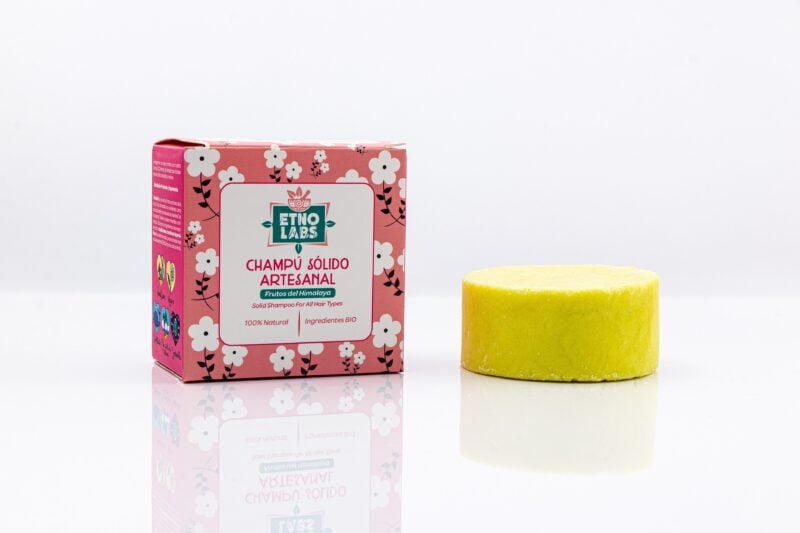
Solid shampoo divides into two broad types. A true soap-based bar, made by saponifying oils and fats with an alkali, is alkaline. A syndet bar — the term is short for synthetic detergent — is built from surfactants pressed into solid form rather than from soap, and can be formulated to a lower pH.
The 2014 paper treats soap as a distinct case among anionic cleansers. Soap in contact with water “leaves an alkaline residue that is very harmful to the hair and skin and that precipitates in the form of calcium salts, which accumulate in the hair strands, leaving them opaque and tangled”, it says. Newer anionic surfactants derived from the sulfation of fatty acids do not produce that effect, according to the authors.
Brands making syndet bars tend to state a range on their own pages. Ethique says its shampoo bars are “100% soap-free, with a pH balance of between 4.5-5.5 – optimally balanced for hair and skin”, and on the same page puts soap at a pH of between 9 and 10. Those are the company’s figures for its own products rather than an independent measurement. A HiBAR collection page talks of keeping a formula “right in the 4.5–5.5 zone”; the brand’s FAQ lists standard shampoo and conditioner bars at a pH of 5.7, with the Soothe shampoo at 3.
Much of the rest of the confusion around solid shampoo, from the first wash to hard water, is covered separately in Eluxe’s run-through of shampoo bar myths and facts, and sits apart from the pH question.
What to check before buying a bar this winter
Three checks follow from the research. First, establish whether the bar is soap or syndet, which usually means reading the maker’s own description of the formula, including any soap-free claim. Second, look for a stated pH from the manufacturer, which the paper’s authors say belongs on the label. Third, decide whether a conditioner will be used, since the advice on staying below pH 5.5 is framed around washing without one.
The same question applies to liquid products, including the organic shampoos that make no claim about acidity at all, and to the wider plastic-free beauty routine. Nothing in the Gavazzoni Dias paper supports the idea that a shampoo, solid or liquid, treats dry hair. What it measured was surface charge, friction and frizz, and what it asked for was that the figure behind those effects be printed where buyers can see it.

- Shampoo bars for dry winter hair, and the case for a pH of 5.5 or lower - November 14, 2026
- Where to rent a Christmas party dress in the UK, from HURR to Hirestreet - November 14, 2026
- Plastic-free Christmas crackers for 2026, from RSPB boxes to reusable fabric sets - November 14, 2026