

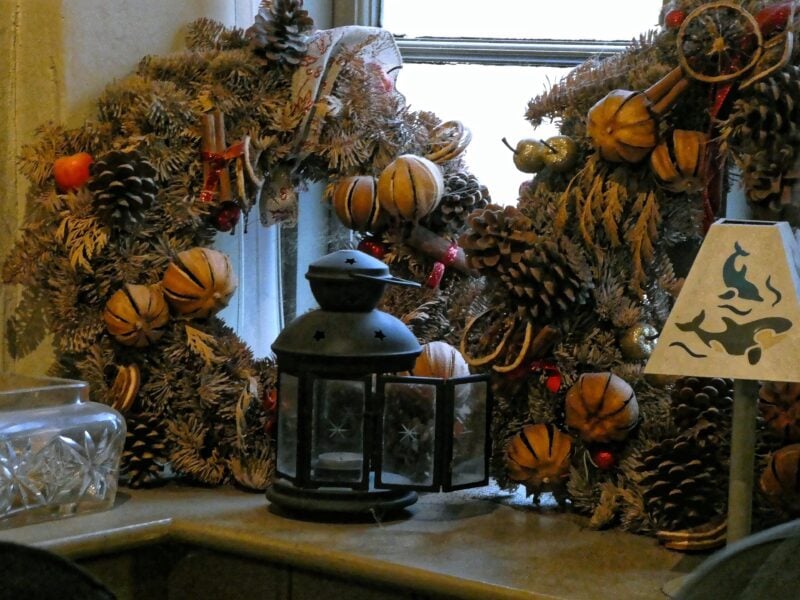
Photo: Acabashi / Wikimedia Commons, CC BY-SA 4.0
The Royal Horticultural Society’s DIY guide to Christmas wreaths gives one instruction before any materials are gathered: “Avoid using floral foam, as this is environmentally harmful.” The guide builds its wreath on a willow, straw or wire ring packed with moss instead.
Traditional floral foam is plastic that crumbles easily into microplastics that wash down the drain, sit in landfill and work their way into waterways, the florist WilderBlooms writes in a post about waste in floristry. The same florist says it never uses wire or plastics when making wreaths and works instead with hand-twisted willow hoops held together with jute twine.
Lots of methods for making wreaths suggest non-biodegradable and single-use materials such as floral foam, Emily Osterloff writes in the Natural History Museum’s guide to eco-friendly Christmas crafts, and it is entirely possible to make one without them.
What a plastic-free wreath leaves out
Foam is the first omission. In its place, the RHS uses a ring of willow, straw or wire covered with teased-out moss, wired on in fist-sized bundles. On sourcing that moss, the society says moss raked from a lawn makes “a more sustainable alternative” to sustainably farmed sphagnum, “as even sustainably farmed sphagnum has considerable air miles”.
Glitter is the second. The RHS says a large amount of wrapping papers and Christmas cards are laminated or impregnated with plastics or glitter, meaning they are impossible to recycle. Official guidance treats the material the same way. The UK government’s recyclability assessment methodology, updated on 4 September 2025, lists “paper and board to which glitter has been adhered” among the variants that are not widely collected at kerbside, and the Separation of Waste (England) Regulations 2024 exclude “paper and card to which glitter has been adhered” from the paper and card waste stream. The same reasoning applies to the parcels under the tree, which is why zero-waste Christmas gift wrapping tends to start with plain paper.
Third are the ties and trims. The Natural History Museum advises using twine and ribbon made of 100% natural fibre, such as cotton. Where a non-biodegradable material such as nylon is used, the museum says to detach it carefully from the wreath before composting and to reuse it the following year.
Dried, foraged and reusable designs
Dried decorations are the first group: dried orange slices, dried flowers and seed heads. The RHS sets out one seed-head design in full. The fluffy seed heads of old man’s beard, Clematis vitalba, are cut into short sections and pushed into a twig ring as natural tinsel. Gentle handling stops the seed heads breaking up, and the society says this wreath is best indoors.
Foraged designs use what is already growing. The RHS lists holly, ivy, spruce and pine as suitable, along with box, Magnolia grandiflora, osmanthus, Viburnum tinus and bay, with twisted stems of hazel, birch, dogwood, willow, honeysuckle and vines for a more rustic ring. The Natural History Museum’s method needs no bought base: find a spot where there is permission to collect, pick foliage varied in size, colour and texture, bend the larger flexible branches into a circle and secure them with twine, then tie on smaller branches and leaves until there are no big gaps.
Three cautions come with foraging. Cuttings of evergreens such as conifer and holly last longer. Berries should be collected in moderation, because they are an important food source for birds in winter. Ivy and berries can be poisonous, so a finished wreath carrying them needs to be kept away from children and pets.
Reusable designs put the spending into the base. A willow, twig or wire ring can be stored and dressed again each December, as can fabric and wool decorations, which is the logic behind the refillable wood and fabric advent calendars sold for 2026. The RHS colour winter stem wreath skips the base entirely: 12 to 15 young, flexible willow or dogwood stems at least 1.5m long, the first bent into a circle 30 to 40cm across and the rest twisted in and out of it, finished with a wire loop for hanging.
How long it lasts, and what happens in January
Timing follows the position. Wreaths hung outdoors last four or five weeks, so the RHS says preparations can begin in late November. Indoor wreaths look fresh for one or two weeks, depending on how warm the room is. A moss-based wreath needs its moss kept moist, misted as needed with rainwater, or the foliage withers.
Taking it down matters as much as making it. A foliage wreath built on a bent-branch base and tied with twine can be composted at the end of the season, the Natural History Museum says, once anything that cannot be composted has been removed and set aside for next year. The RHS puts it the same way: take off all wire, as well as any ribbons or plastic-based components such as tinsel, before composting, and all of those items can usually be reused.
Wreaths also make a great, sustainable present for friends and neighbours, the RHS says, which places them alongside the rest of a homemade plastic-free gift list. Smaller versions work on the table: mini cranberry wreath place cards are one of the plastic-free Christmas decoration ideas Eluxe has run before, and they sit easily next to plastic-free Christmas crackers.

- Beeswax-free solid hand balms that use plant waxes such as candelilla and sunflower instead - November 15, 2026
- Ethical knitwear for winter 2026, from British wool jumpers to recycled wool sweaters - November 15, 2026
- Plastic-free Christmas wreaths 2026 with dried, foraged and reusable designs - November 14, 2026