

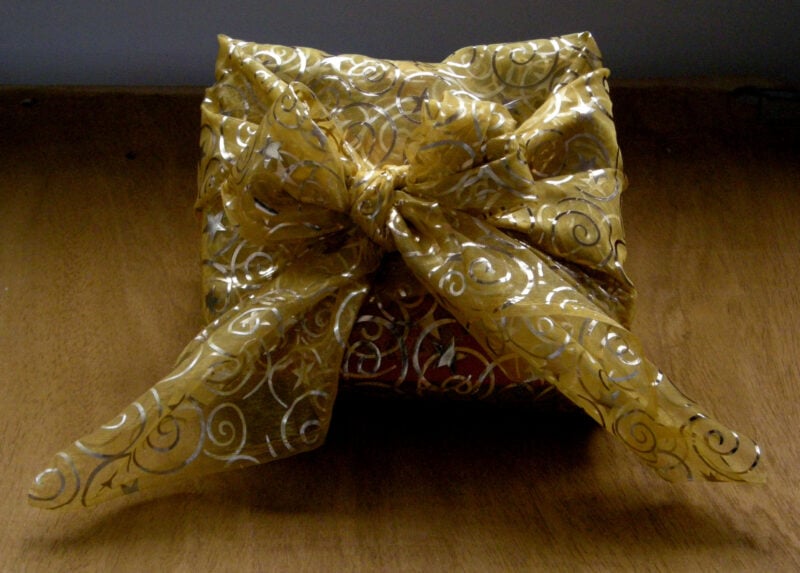
Furoshiki, the traditional Japanese cloths used to wrap presents instead of paper, are one way of avoiding gift wrap altogether, according to the BBC’s Reality Check team, which examined whether Christmas wrapping paper can be recycled. The cloth can be reused in future years or given as a gift itself.
The question comes up every December because gift wrap is often not simply paper. Some is plastic-based. Some is laminated with plastic. Paper that contains foil or glitter cannot be recycled, and nor can gift tags.
“It’s a nightmare for paper mills this time of year,” Simon Ellin, chief executive of the Recycling Association, told the BBC. The trade body represents around 90 paper merchants, waste management companies and other businesses involved in recycling paper. Mills are presented with mountains of wrapping paper and cannot work with all of it.
The scrunch test, and what fails it
The quickest check is the one set out by both the BBC and the consumer group Which?. Scrunch a sheet into a ball in the hand and release it. If it stays scrunched, it is generally recyclable. If it springs back, Which? says it is likely to be laminated with plastic or foil-based, and cannot be recycled.
Which? adds a second check, the tear test: paper that cannot be ripped easily by hand is likely to be made of materials other than paper, so it goes in with normal household rubbish. Glitter rules a sheet out whichever way it scrunches, and the same applies to Christmas cards, so glittery versions of either are best avoided at the point of purchase.
Tape matters too. Plastic sticky tape should be removed before paper goes in the bin, while paper parcel tape and some paper-based washi tapes can be recycled with the wrapping, Which? says. Ribbons and bows are often polyester, are difficult to recycle and can clog recycling machinery, so they are better kept and used again.
Even recyclable paper is not accepted everywhere. Some councils take it in kerbside collections, others ask residents to bring it to a household recycling centre, and some say they cannot accept wrapping paper at all because of paper quality and the risk of contamination. Local authority websites carry the rules.
Furoshiki and wrapping that gets used again
Fabric avoids the sorting problem. Which? describes wrapping gifts in pieces of fabric as a stylish alternative to paper that can be used again and again, and names the traditional Japanese technique, furoshiki wrapping, as one that can yield impressive results. The BBC makes the same point: the cloth can be reused in later years, or form part of the present.
Reuse applies to paper as well. Which? suggests building the habit of salvaging good sheets of wrapping paper, tissue paper, cardboard boxes and parcel wrap, along with ribbons, bows and gift bags, then using them again. Old newspaper and magazine pages are another option, and cut-up Christmas cards can be turned into gift labels. Broader household cuts are collected in Eluxe’s tips for a zero waste lifestyle.
The Environment Agency has suggested making wrapping paper at home as a way of encouraging reuse, recommending potato stamps to decorate parcel paper and a sprig of holly “for that Christmas feel”. What goes inside the cloth or the paper can follow the same logic: ideas for plastic-free homemade Christmas gifts cut packaging before the wrapping stage.
Brown paper, string and dried orange slices
Where paper is wanted, brown or coloured kraft paper is the safer choice. Which? says all councils and recycling centres should accept it, because it has long, high-quality fibres, and that it is often made from partially recycled paper to start with. Very thin paper may be technically recyclable but can contain too little quality fibre to be worth processing, while foil shapes and laminate finishes reduce the fibre that can be recovered.
Steve Oulds, commercial manager for waste-management company Biffa’s material recycling facilities, told Which?: “While composite materials may still be recyclable, recycling them becomes more difficult as more processes (and more costs) are involved to return them to being pure paper again.”
Plain brown paper can be made festive with a stamp or paints and tied with string, Which? says, with dried flowers, sprigs of seasonal foliage or cinnamon bark added for extra effect. Dried orange slices work in the same way, threaded onto twine or tucked under the string for colour without foil or glitter. The same natural materials carry over into plastic-free Christmas decoration ideas.
Retailers have moved on glitter. For a guide published in December 2025, Which? gathered information from retailers’ websites in December 2024 and asked retailers directly where it was not online. Asda went plastic- and glitter-free across its Christmas card and wrapping ranges in 2020 and all its paper is FSC-certified. John Lewis and Waitrose, Morrisons and Sainsbury’s sell wrapping paper that is recyclable and FSC-certified, while Tesco, including Paperchase, says its wrapping paper, cards, gift bags and crackers are widely recyclable and glitter-free. A recyclability claim does not guarantee that a particular council will accept the paper.
Figures for the scale of Christmas packaging waste should be treated with care. The packaging supplier GWP, in a guide to Christmas packaging facts last updated on 10 November 2026 by Matt Dobson, puts UK wrapping paper use at 227,000 miles a year and plastic packaging thrown away over the holiday season at as much as 114,000 tonnes. GWP says the article is a round-up of statistics from various sources across the web and that the figures have not been researched or verified by GWP Group. The BBC cites the same 227,000-mile estimate for wrapping paper thrown away each Christmas in the UK, attributing it to the waste management company Biffa.
GWP’s guide also sets out the scrunch test, says no glitter-covered card or paper should be recycled, and recommends brown paper as the wrap that makes recycling easiest for the person opening the gift.

- Plastic-free stocking fillers for Christmas 2026, from vegan soap to bamboo cotton swabs - November 13, 2026
- Recycled cashmere brands with traceable supply chains, from Stella McCartney to Lanaioli - November 13, 2026
- Sustainable fashion brands sitting out Black Friday 2026, from Finisterre’s Blue Friday to Mia Fratino - November 13, 2026