

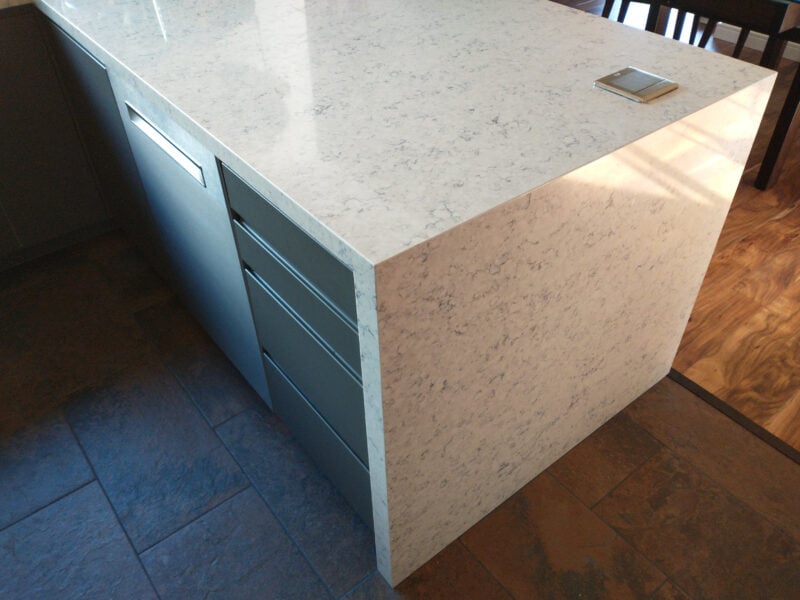
Photo: An engineered quartz kitchen countertop installed in California in 2023 (generic; not a named brand or a fabrication workshop). Stilfehler / Wikimedia Commons, CC BY-SA 4.0. Share-alike: derivatives must use the same licence.
Silicosis among the stoneworkers who cut, grind and polish engineered quartz has moved California’s workplace safety regulator to propose a ban on making the material. On 22 October 2026 Cal/OSHA posted an updated discussion draft titled “Prohibition of Fabrication and Manufacture of Artificial Stone with 1.0% or more Crystalline Silica”, with comments due by 30 October.
Nothing has been adopted. This is a proposed workplace regulation, not legislation, and it does not appear on the agenda for the Occupational Safety and Health Standards Board meeting in Monterey on 19 November. KQED said on 10 November that the board is “poised to vote on a first-in-the-nation emergency regulation next month, amid strong industry opposition”. That timing comes from the outlet, not from a published board agenda.
The draft would apply in the workshop rather than the home. It covers the fabrication and manufacture of high-silica artificial stone, the stages at which cutting and polishing release the dust that causes silicosis. It would not ban owning quartz.
Where the proposed rule stands
The process began on 21 May 2026, when the Standards Board voted to grant a petition submitted on behalf of the Western Occupational and Environmental Medicine Association. As the Department of Industrial Relations set out in its news release, the petition initiated a process to prohibit the fabrication and installation of artificial stone products containing more than 1 per cent crystalline silica. In its unanimous decision, the board asked Cal/OSHA to prepare the finding of emergency required for expedited rulemaking.
Cal/OSHA then worked in public. A discussion draft for a proposed new section 5204.1 went out on 16 September, with comments due by 30 September. The updated draft followed on 22 October, and its title narrows the May wording: fabrication and manufacture, rather than fabrication and installation.
California would not be first. KQED notes that Australia was the first country to ban engineered stone slabs, in 2024.
What the illness figures show
The case counts come from the California Department of Public Health, which tracks silicosis among countertop fabrication workers. In a letter dated 30 September 2026 to Cal/OSHA chief Debra Lee, the department wrote: “As of September 16, 2026, CDPH has identified 644 cases of silicosis among engineered stone countertop fabrication workers in California, including at least 35 deaths, 75 individuals who have undergone lung transplants, and 53 others who have been referred for a lung transplant.”
The total has since risen. KQED put it at more than 680 stoneworkers on 10 November. The department’s surveillance dashboard is updated weekly. A live total could not be read from that dashboard on 16 November, because the figure is shown in an interactive chart rather than as a static number, so this article keeps the dated 16 September letter figures and KQED’s 10 November count.
The material is the reason. Engineered stone slabs, sold as quartz and also called artificial stone, can contain more than 90 per cent pulverised crystalline silica, according to occupational medicine specialists who testified before state regulators. Cutting and polishing turn that silica into a fine dust.
The American Medical Association has adopted a policy opposing the manufacturing, importation, distribution, sale, fabrication and installation of high-silica engineered stone products across the United States. Sheila Rege, an AMA board member, said workers are developing “an incurable lung disease that can progress to respiratory failure and sometimes, death, often at a young age among workers”. She added: “Silicosis is preventable, and the most effective way to prevent silicosis is to use safer countertop materials containing less than 1% crystalline silica with appropriate dust control measures.”
What to choose instead
For anyone specifying a kitchen in the next few months, the question is what goes in the slab slot. Two sets of recommendations sit on the public record.
- Lower-silica stone and porcelain. The AMA recommends alternatives with lower crystalline silica content, naming marble, granite and porcelain. Lower is not none: the association frames these as lower in silica, not free of it, and fabricating them still produces dust that has to be controlled.
- Non-stone surfaces. The health department’s letter to Cal/OSHA says alternatives to engineered stone are already marketed in California, and mentions “low silica natural stones such as marble” alongside stainless steel and wood.
- Reformulated engineered slabs. Some large manufacturers, among them Spain-based Cosentino and the Israeli company Caesarstone, have developed products they advertise as having low or no crystalline silica. Those are the companies’ own descriptions.
Wood and metal worktops have been in kitchens far longer than engineered quartz, and buyers weighing durability against footprint can start with Eluxe’s earlier look at eco-friendly worktops. The same questions of materials and finish come up in Eluxe’s tips for an eco-friendly interior design makeover.
Two questions are worth putting to a supplier before signing anything. First, what percentage of crystalline silica the slab contains, in writing, rather than a general assurance that it is low in silica. Second, how the fabricator handles the dust, since Rege paired safer materials with “appropriate dust control measures” rather than treating the material swap as sufficient on its own.
Countertops already fitted are not the subject of the draft, which addresses fabrication and manufacture. The exposure described in the record falls on the workers who cut, grind and polish the slabs.
Comments on the updated draft closed on 30 October. The next step rests with the Standards Board, whose published agenda for 19 November carries no silica item.

- Gmail alternatives that run on green energy: Tuta, Posteo and mailbox.org encrypt mail in Germany - November 16, 2026
- A 20p deposit on plastic bottles and cans starts in England, Scotland and Northern Ireland on 1 October 2027 - November 16, 2026
- Silicosis among the workers who cut quartz countertops has California proposing a ban: what to choose instead - November 16, 2026