

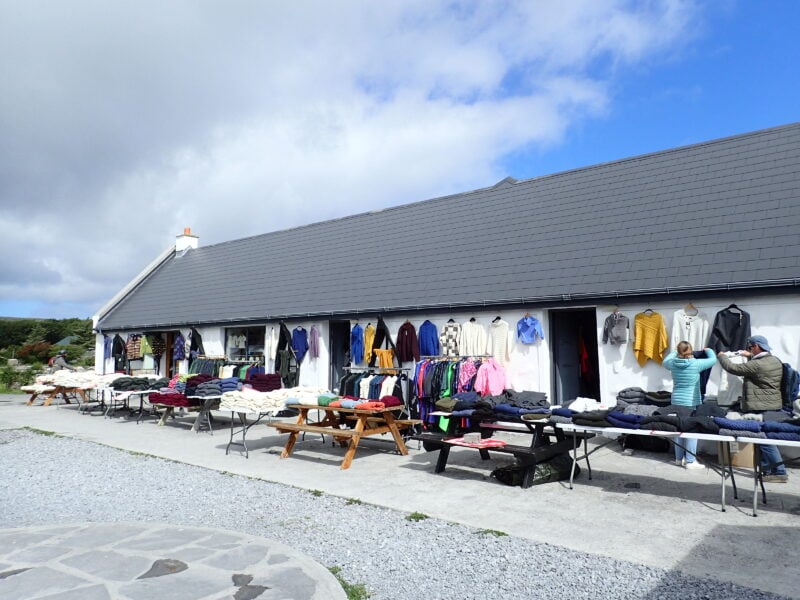
Photo: wool knitwear on sale on the Aran Islands (stand-in; not the brands named in the article). Marathon / Wikimedia Commons, CC BY-SA 2.0

Knitwear is one of the few parts of a winter wardrobe where the supply chain is short enough to follow on a single product page: fleece off a sheep, scoured and spun, knitted into panels, then linked and finished. Four knits from three labels set that route out in detail, and the gaps between them explain much of what separates a £79 crew neck from a £295 one.
Community Clothing sells a two-ply merino lambswool jumper at £79, spun in Yorkshire and knitted in Hawick. Navygrey lists the British Cheviot Crew at £295, in a Bluefaced Leicester and Scottish Cheviot yarn developed with British Wool. Patagonia also sells a men’s recycled wool-blend sweater, but its official product page was down for maintenance on 15 November 2026, so no current price is given here. The Community Clothing and Navygrey prices were checked on the brands’ own pages the same day and can move, so confirm before ordering.
British wool, spun in Yorkshire and knitted in Scotland
Community Clothing’s lambswool page asks why its £79 jumper lasts 20 years, then answers with addresses. The yarn is pure merino lambswool spun by Z. Hinchliffe in Denby Dale, Yorkshire, a firm the brand says has been spinning for over 250 years and supplies some of the best-known luxury labels in the world. Knitting happens in Hawick, the border town where Pringle and Lyle & Scott were once made. Neither is made there now, the brand says, and its own mill also knits for designer labels selling near-identical jumpers for a great deal more, which is why the mill goes unnamed. Community Clothing puts the Hawick finish down to the detergents, the wash time and the cycle, but above all the soft Scottish water. Crew necks and V-necks are £79, cardigans £122.
The heavier option from the same label is the Lambswool Fisherman Ribbed Jumper in charcoal, at £144. It is 100 per cent British wool, knitted on a heavy gauge using four ends of yarn, hand-linked and finished in Scotland from yarn spun in Yorkshire. The brand says the jumper was made by its knitter for the British Army, which fits the suede elbow and shoulder patches and the description of it as tough and warm enough for winter outdoor work. On a hand-linked seam an operator matches the stitches one by one rather than running the panels through an overlocker, which keeps the shoulder flat and the seam flexible. It is slow work, and part of what sits inside the price.
Navygrey’s chunky crew, listed in the brand’s womenswear, sits at the other end of the same route. The yarn is Navygrey’s own, developed in partnership with British Wool, and splits 30 per cent Cheviot, sourced mainly from farms in Aberdeenshire and the Orkneys, and 70 per cent Bluefaced Leicester, which the brand calls one of the softest wools in the British Isles. It is “spun and dyed in Yorkshire, and knitted and hand-finished in Scotland”, at a chunky 3gg gauge. Navygrey is plain about the character of the fibre: more fibrous and edgy than its smoother Scottish-spun wool, with “a little more kick to it”, and a feel it describes as “something your grandparents would have worn”. UK delivery is complimentary on orders over £250. In the mid-November check the small was sold out, with the page flagging last few remaining.
Recycled wool, and what the nylon is doing in it
Recycled wool behaves differently. Reclaimed fibre is shorter than virgin fibre, because shredding old garments or mill offcuts breaks the staple, so recycled yarns are usually blended to hold their strength. A recycled wool sweater is often mixed with other fibres so the shorter staple holds together; mixed fibres are also harder to separate at the end of a garment’s life than a single-fibre knit. That trade-off is the honest reading of any blend. Exact fibre percentages for the Patagonia sweater should be read from the product page once it is back up.
The same arithmetic applies at the fine end of the fibre market, where reclaimed cashmere is usually blended for durability and where traceability back to named sources is the other half of the question. Both routes turn up in the Eluxe guide to recycled cashmere knitwear brands and in the list of recycled and traceable cashmere brands.
Reading a product page before buying
Four details separate a knit worth keeping from one that pills flat by February. Fibre content given as percentages rather than adjectives. A named spinner or mill, or at least a named town. Construction, since hand-linked, fully fashioned and heavy-gauge knits all cost money and all add to the life of the garment. And weight: a chunky 3gg crew and a two-ply lambswool jumper are not substitutes, and buying the wrong one for the way a wardrobe actually works is the most common waste.
Care instructions on these pages are specific and worth following. Community Clothing recommends a gentle hand wash at 30 degrees with a mild detergent, a lukewarm rinse, no wringing or rubbing, reshaping while the knit is still wet, drying flat on a towel, no fabric conditioner, a low iron and no dry cleaning. Navygrey takes a harder line, suggesting airing rather than washing wherever possible, a hand wash in a basin only now and then, and a specialist fabric shaver for the pilling that it says soft fibres are liable to develop to some extent.
Fibre and factory are only part of the picture, and prices shift through the season, so check them again before ordering. For a wider set of makers working to similar standards, see the round-up of ethical knitwear brands.

- Beeswax-free solid hand balms that use plant waxes such as candelilla and sunflower instead - November 15, 2026
- Ethical knitwear for winter 2026, from British wool jumpers to recycled wool sweaters - November 15, 2026
- Plastic-free Christmas wreaths 2026 with dried, foraged and reusable designs - November 14, 2026